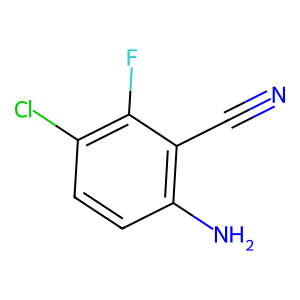
6-Amino-3-chloro-2-fluorobenzonitrile
Names and Identifiers of 6-Amino-3-chloro-2-fluorobenzonitrile
CAS Number |
1000577-64-9 |
|---|---|
MDL Number |
MFCD09800807 |
IUPAC Name |
6-amino-3-chloro-2-fluorobenzonitrile |
InChI |
InChI=1S/C7H4ClFN2/c8-5-1-2-6(11)4(3-10)7(5)9/h1-2H,11H2 |
InChIKey |
IWKYFJYZLOWWKJ-UHFFFAOYSA-N |
Canonical SMILES |
C1=CC(=C(C(=C1N)C#N)F)Cl |
UNSPSC Code |
12352100 |
Physical and chemical properties of 6-Amino-3-chloro-2-fluorobenzonitrile
Exact Mass |
170.00500 |
|---|---|
LogP |
2.51418 |
Molecular Formula |
C7H4ClFN2 |
Molecular Weight |
170.57100 |
PSA |
49.81000 |
Safety Information of 6-Amino-3-chloro-2-fluorobenzonitrile

Applications of 6-Amino-3-chloro-2-fluorobenzonitrile
6-Amino-3-chloro-2-fluorobenzonitrile serves multiple purposes across various domains:
- Medicinal Chemistry: It acts as a building block for synthesizing biologically active compounds, potentially leading to new pharmaceuticals.
- Agrochemicals: The compound may be used in developing agrochemical products due to its unique chemical properties.
- Specialty Chemicals: In the chemical industry, it is utilized for producing dyes, pigments, and other specialty chemicals.
Interaction Studies of 6-Amino-3-chloro-2-fluorobenzonitrile
Studies on 6-Amino-3-chloro-2-fluorobenzonitrile's interactions with biological systems reveal its potential as a probe in biochemical research. Its unique combination of functional groups allows it to interact with enzymes or receptors, modulating their activity. This reactivity is crucial for understanding its biological mechanisms and developing applications in drug design.
Biological Activity of 6-Amino-3-chloro-2-fluorobenzonitrile
The biological activity of 6-Amino-3-chloro-2-fluorobenzonitrile is primarily linked to its potential interactions with biological targets. The compound may exhibit enzyme inhibition or receptor modulation due to its functional groups, which can enhance binding affinity and specificity. Research indicates that halogenated compounds like this one can influence biological pathways, making them valuable in drug development and biochemical studies.