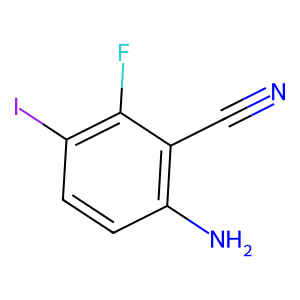
6-Amino-2-fluoro-3-iodobenzonitrile
Names and Identifiers of 6-Amino-2-fluoro-3-iodobenzonitrile
CAS Number |
1000577-82-1 |
|---|---|
EC Number |
825-483-2 |
MDL Number |
MFCD09800813 |
IUPAC Name |
6-amino-2-fluoro-3-iodobenzonitrile |
InChI |
InChI=1S/C7H4FIN2/c8-7-4(3-10)6(11)2-1-5(7)9/h1-2H,11H2 |
InChIKey |
NXYRGTVCZLTGEZ-UHFFFAOYSA-N |
Canonical SMILES |
C1=CC(=C(C(=C1N)C#N)F)I |
UNSPSC Code |
12352100 |
Physical and chemical properties of 6-Amino-2-fluoro-3-iodobenzonitrile
Exact Mass |
261.94000 |
|---|---|
LogP |
2.46538 |
Molecular Formula |
C7H4FIN2 |
Molecular Weight |
262.02300 |
PSA |
49.81000 |
Safety Information of 6-Amino-2-fluoro-3-iodobenzonitrile

Applications of 6-Amino-2-fluoro-3-iodobenzonitrile
6-Amino-2-fluoro-3-iodobenzonitrile has several applications across different fields:
- Chemistry: It serves as an intermediate in the synthesis of complex organic molecules and heterocycles.
- Biology: It is used in developing bioactive compounds and molecular probes.
- Medicine: The compound acts as a precursor for synthesizing pharmaceutical agents with potential therapeutic effects.
- Industry: It finds use in producing specialty chemicals and materials.
Interaction Studies of 6-Amino-2-fluoro-3-iodobenzonitrile
The interaction studies of 6-Amino-2-fluoro-3-iodobenzonitrile focus on its binding capacity with biological targets. These studies aim to elucidate the mechanisms by which this compound may exert its biological effects, particularly in drug discovery contexts. Understanding these interactions is crucial for optimizing its efficacy as a pharmaceutical agent.
Biological Activity of 6-Amino-2-fluoro-3-iodobenzonitrile
Research indicates that 6-Amino-2-fluoro-3-iodobenzonitrile may exhibit biological activity through its interactions with various molecular targets. The compound's structural features can enhance binding affinity and specificity towards enzymes, receptors, or nucleic acids. This makes it a candidate for further investigation in drug development, particularly in the synthesis of bioactive compounds with potential anticancer and antimicrobial properties.