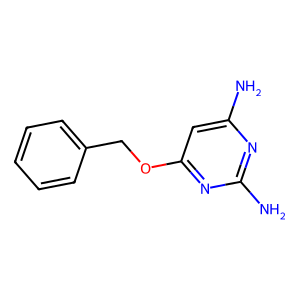
6-(Benzyloxy)pyrimidine-2,4-diamine
Names and Identifiers of 6-(Benzyloxy)pyrimidine-2,4-diamine
CAS Number |
100061-59-4 |
|---|---|
IUPAC Name |
6-phenylmethoxypyrimidine-2,4-diamine |
InChI |
InChI=1S/C11H12N4O/c12-9-6-10(15-11(13)14-9)16-7-8-4-2-1-3-5-8/h1-6H,7H2,(H4,12,13,14,15) |
InChIKey |
MVIHQMTVQZOYCE-UHFFFAOYSA-N |
Canonical SMILES |
C1=CC=C(C=C1)COC2=NC(=NC(=C2)N)N |
Physical and chemical properties of 6-(Benzyloxy)pyrimidine-2,4-diamine
Exact Mass |
216.10100 |
|---|---|
LogP |
2.38240 |
Melting Point |
104-106oC |
Molecular Formula |
C11H12N4O |
Molecular Weight |
216.23900 |
PSA |
87.05000 |
Solubility |
DMSO (Slightly), Methanol (Slightly) |
Storage condition |
Refrigerator |
Applications of 6-(Benzyloxy)pyrimidine-2,4-diamine
The primary applications of 2,6-diamino-4-(benzyloxy)pyrimidine lie in medicinal chemistry and drug development. Its antiproliferative properties make it a candidate for further investigation as a potential anticancer agent. Additionally, its structural analogs may serve as lead compounds for developing new therapies targeting specific diseases, particularly those involving dysregulated cell growth.
Interaction Studies of 6-(Benzyloxy)pyrimidine-2,4-diamine
Interaction studies have focused on understanding how 2,6-diamino-4-(benzyloxy)pyrimidine interacts with various biological targets. These studies often employ techniques such as molecular docking and enzymatic assays to elucidate binding affinities and mechanisms of action. The compound's ability to inhibit specific kinases has been noted, suggesting that it could play a role in modulating critical signaling pathways involved in cancer biology.
Biological Activity of 6-(Benzyloxy)pyrimidine-2,4-diamine
Research indicates that 2,6-diamino-4-(benzyloxy)pyrimidine exhibits significant antiproliferative activity against various cancer cell lines. Its mechanism of action may involve the inhibition of specific kinases or other molecular targets involved in cell proliferation and survival. Studies have shown that pyrimidine derivatives can modulate signaling pathways related to cancer progression, making them valuable candidates for anticancer therapies.
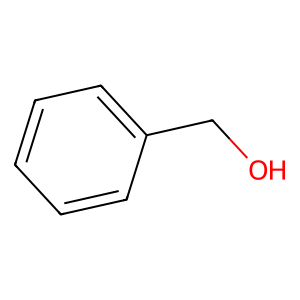 Cas:100-51-6

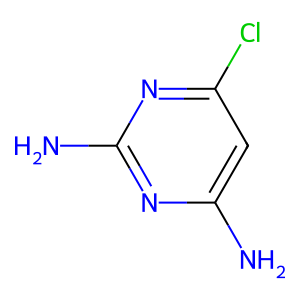 Cas:156-83-2
