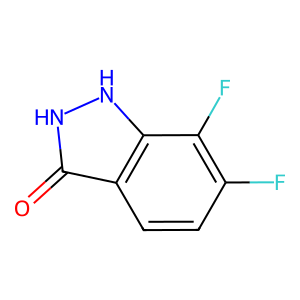
6,7-DIFLUORO-3-HYDROXY (1H)INDAZOLE
Names and Identifiers of 6,7-DIFLUORO-3-HYDROXY (1H)INDAZOLE
CAS Number |
1000343-93-0 |
|---|---|
IUPAC Name |
6,7-bis(fluoranyl)-1,2-dihydroindazol-3-one |
Canonical SMILES |
C1=CC(=C(C2=C1C(=O)NN2)F)F |
Physical and chemical properties of 6,7-DIFLUORO-3-HYDROXY (1H)INDAZOLE
Boiling Point |
374.9±37.0 °C at 760 mmHg |
|---|---|
Density |
1.7±0.1 g/cm3 |
Exact Mass |
170.029175 |
Flash Point |
180.5±26.5 °C |
Index of Refraction |
1.679 |
LogP |
1.77 |
Molecular Formula |
C7H4F2N2O |
Molecular Weight |
170.116 |
PSA |
48.91000 |
Vapour Pressure |
0.0±0.9 mmHg at 25°C |
Applications of 6,7-DIFLUORO-3-HYDROXY (1H)INDAZOLE
6,7-Difluoro-1H-indazol-3-ol has potential applications in various fields:
- Pharmaceutical Development: Its antitumor activity makes it a candidate for further development as an anticancer drug.
- Chemical Research: It serves as a valuable intermediate in the synthesis of more complex indazole derivatives with tailored biological activities.
- Material Science: Due to its unique chemical properties, it may find applications in developing new materials with specific functionalities.
Interaction Studies of 6,7-DIFLUORO-3-HYDROXY (1H)INDAZOLE
Studies on the interactions of 6,7-difluoro-1H-indazol-3-ol with biological targets have shown promising results. The compound's ability to modulate protein interactions suggests it could play a role in altering cellular pathways involved in cancer progression. Investigations into its binding affinities and mechanisms are ongoing, aiming to elucidate how structural modifications impact its biological effects.
Biological Activity of 6,7-DIFLUORO-3-HYDROXY (1H)INDAZOLE
Research indicates that 6,7-difluoro-1H-indazol-3-ol exhibits notable biological activities. It has been studied for its potential antitumor properties, with findings suggesting that its structure enhances its binding affinity to specific biological targets. The presence of fluorine atoms may improve the compound's lipophilicity and permeability, contributing to its efficacy against various cancer cell lines. Its mechanism of action may involve modulation of protein interactions, such as influencing p53 and MDM2 pathways, which are critical in cancer biology.