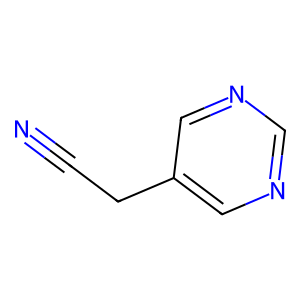
5-Pyrimidineacetonitrile
CAS No.:
1000564-45-3
M. Wt:
119.12400
M. Fa:
C6H5N3
InChI Key:
WBXNRDHUHUWTDU-UHFFFAOYSA-N
Appearance:
yellow solid
Names and Identifiers of 5-Pyrimidineacetonitrile
CAS Number |
1000564-45-3 |
|---|---|
MDL Number |
MFCD09923687 |
IUPAC Name |
2-pyrimidin-5-ylacetonitrile |
InChI |
InChI=1S/C6H5N3/c7-2-1-6-3-8-5-9-4-6/h3-5H,1H2 |
InChIKey |
WBXNRDHUHUWTDU-UHFFFAOYSA-N |
Canonical SMILES |
C1=C(C=NC=N1)CC#N |
UNSPSC Code |
12352100 |
Physical and chemical properties of 5-Pyrimidineacetonitrile
Acidity coefficient |
1.53±0.10(Predicted) |
|---|---|
Boiling Point |
268.4±15.0 °C(Predicted) |
Density |
1.166±0.06 g/cm3(Predicted) |
Exact Mass |
119.04800 |
LogP |
0.54268 |
Molecular Formula |
C6H5N3 |
Molecular Weight |
119.12400 |
PSA |
49.57000 |
Safety Information of 5-Pyrimidineacetonitrile

Applications of 5-Pyrimidineacetonitrile
5-Pyrimidineacetonitrile finds applications across several fields:
- Pharmaceuticals: It serves as an intermediate in the synthesis of drugs targeting various diseases, particularly infectious diseases and cancer.
- Agriculture: Compounds derived from 5-Pyrimidineacetonitrile are explored for use as herbicides or fungicides due to their biological activity against pests.
- Material Science: It can be utilized in developing new materials with specific electronic or optical properties.
The versatility of this compound makes it valuable in both research and industrial contexts.
Interaction Studies of 5-Pyrimidineacetonitrile
Interaction studies involving 5-Pyrimidineacetonitrile focus on its binding affinities with biological targets such as enzymes and receptors:
- Molecular Docking Studies: These studies help predict how well 5-Pyrimidineacetonitrile binds to specific protein targets, providing insights into its potential efficacy as a drug candidate.
- In Vitro Assays: Laboratory tests are conducted to evaluate its biological activity against various pathogens or cancer cell lines, assessing its therapeutic potential.
Such studies are essential for understanding the compound's mechanism of action and optimizing its pharmacological properties.
Biological Activity of 5-Pyrimidineacetonitrile
5-Pyrimidineacetonitrile exhibits significant biological activity, particularly in the fields of pharmacology and agrochemicals. Research has indicated that it may possess:
- Antimicrobial Properties: Studies have shown that compounds with similar structures can inhibit the growth of bacteria and fungi.
- Anticancer Activity: Some derivatives of pyrimidine compounds have demonstrated cytotoxic effects against cancer cell lines, suggesting potential as chemotherapeutic agents.
- Enzyme Inhibition: It may interact with specific enzymes, altering their activity and impacting metabolic pathways.
The exact biological mechanisms are still under investigation, but the compound's structural features suggest promising therapeutic potentials.