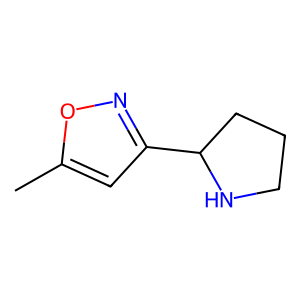
5-Methyl-3-pyrrolidin-2-ylisoxazole
Names and Identifiers of 5-Methyl-3-pyrrolidin-2-ylisoxazole
CAS Number |
1000932-34-2 |
|---|---|
EC Number |
822-156-6 |
MDL Number |
MFCD09863362 |
IUPAC Name |
5-methyl-3-pyrrolidin-2-yl-1,2-oxazole |
InChI |
InChI=1S/C8H12N2O/c1-6-5-8(10-11-6)7-3-2-4-9-7/h5,7,9H,2-4H2,1H3 |
InChIKey |
QHCHHBRSMFGRQX-UHFFFAOYSA-N |
Canonical SMILES |
CC1=CC(=NO1)C2CCCN2 |
UNSPSC Code |
12352100 |
Physical and chemical properties of 5-Methyl-3-pyrrolidin-2-ylisoxazole
Exact Mass |
152.09500 |
|---|---|
LogP |
1.73630 |
Molecular Formula |
C8H12N2O |
Molecular Weight |
152.19400 |
PSA |
38.06000 |
Safety Information of 5-Methyl-3-pyrrolidin-2-ylisoxazole

Applications of 5-Methyl-3-pyrrolidin-2-ylisoxazole
5-Methyl-3-pyrrolidin-2-ylisoxazole has potential applications in various fields:
- Pharmaceuticals: Due to its biological activity, it may be explored as a lead compound for drug development targeting inflammation or microbial infections.
- Chemical Research: Its unique structure makes it a valuable scaffold for synthesizing other complex organic compounds.
Interaction Studies of 5-Methyl-3-pyrrolidin-2-ylisoxazole
Interaction studies involving 5-Methyl-3-pyrrolidin-2-ylisoxazole are crucial for understanding its mechanism of action. Research typically focuses on its binding affinity with biological targets such as enzymes or receptors. Preliminary studies suggest that similar compounds can interact with neurotransmitter systems, indicating potential applications in neuropharmacology.
Biological Activity of 5-Methyl-3-pyrrolidin-2-ylisoxazole
Research indicates that 5-Methyl-3-pyrrolidin-2-ylisoxazole exhibits notable biological activities. Isoxazole derivatives are often studied for their potential as anti-inflammatory, analgesic, and antimicrobial agents. Specific studies have shown that compounds with similar structures can modulate various biological pathways, suggesting that 5-Methyl-3-pyrrolidin-2-ylisoxazole may also possess therapeutic properties.