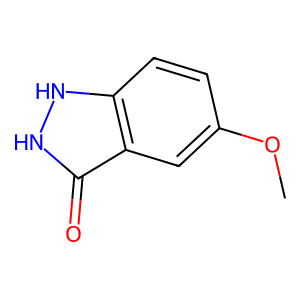
5-Methoxy-1H-indazol-3-ol
Names and Identifiers of 5-Methoxy-1H-indazol-3-ol
CAS Number |
99719-37-6 |
|---|---|
MDL Number |
MFCD10697927 |
IUPAC Name |
5-methoxy-1,2-dihydroindazol-3-one |
InChI |
InChI=1S/C8H8N2O2/c1-12-5-2-3-7-6(4-5)8(11)10-9-7/h2-4H,1H3,(H2,9,10,11) |
InChIKey |
JVIODNHCPBUTPK-UHFFFAOYSA-N |
Canonical SMILES |
COC1=CC2=C(C=C1)NNC2=O |
UNSPSC Code |
12352100 |
Physical and chemical properties of 5-Methoxy-1H-indazol-3-ol
Boiling Point |
396.5±22.0 °C at 760 mmHg |
|---|---|
Density |
1.4±0.1 g/cm3 |
Exact Mass |
164.058578 |
Flash Point |
193.6±22.3 °C |
H Bond Acceptors |
3 |
H Bond Donors |
2 |
Index of Refraction |
1.695 |
LogP |
1.37 |
Molecular Formula |
C8H8N2O2 |
Molecular Weight |
164.161 |
PSA |
58.14000 |
Storage condition |
2-8°C |
Vapour Pressure |
0.0±1.0 mmHg at 25°C |
Safety Information of 5-Methoxy-1H-indazol-3-ol

Applications of 5-Methoxy-1H-indazol-3-ol
5-Methoxy-1H-indazol-3-ol has potential applications in:
- Pharmaceutical Development: Due to its biological activity, it is being explored as a lead compound for developing new drugs targeting neurological conditions.
- Chemical Research: It serves as a building block for synthesizing more complex indazole derivatives with tailored biological properties.
Interaction Studies of 5-Methoxy-1H-indazol-3-ol
Studies focusing on the interaction of 5-methoxy-1H-indazol-3-ol with biological targets have revealed insights into its mechanism of action. For instance, its inhibition of monoamine oxidase enzymes suggests that it may modulate neurotransmitter levels, thereby influencing mood and cognitive functions. Detailed kinetic studies have been conducted to ascertain its binding affinity and inhibitory constants (IC50 values) against MAO enzymes.
Biological Activity of 5-Methoxy-1H-indazol-3-ol
Research has demonstrated that 5-methoxy-1H-indazol-3-ol exhibits significant biological activity, particularly as an inhibitor of monoamine oxidase enzymes. These enzymes are crucial in the metabolism of neurotransmitters and are implicated in various neurological disorders. Studies have shown that derivatives of indazole, including this compound, can inhibit both MAO-A and MAO-B isoforms, with varying potencies depending on substituents.
Physical sample testing spectrum (NMR) of 5-Methoxy-1H-indazol-3-ol
