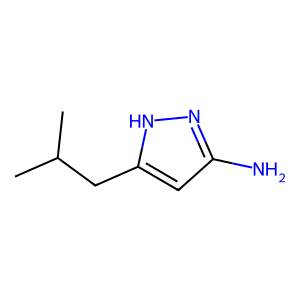
5-Isobutyl-1H-pyrazol-3-amine
Names and Identifiers of 5-Isobutyl-1H-pyrazol-3-amine
CAS Number |
1000896-88-7 |
|---|---|
EC Number |
819-121-2 |
MDL Number |
MFCD17078840 |
IUPAC Name |
5-(2-methylpropyl)-1H-pyrazol-3-amine |
InChI |
InChI=1S/C7H13N3/c1-5(2)3-6-4-7(8)10-9-6/h4-5H,3H2,1-2H3,(H3,8,9,10) |
InChIKey |
QDBRDMCFYCUCPL-UHFFFAOYSA-N |
Canonical SMILES |
CC(C)CC1=CC(=NN1)N |
UNSPSC Code |
12352100 |
Physical and chemical properties of 5-Isobutyl-1H-pyrazol-3-amine
Acidity coefficient |
15.84±0.10(Predicted) |
|---|---|
Boiling Point |
314.6±22.0 °C(Predicted) |
Density |
1.075±0.06 g/cm3(Predicted) |
Exact Mass |
139.11100 |
LogP |
1.12050 |
Melting Point |
109-112 °C |
Molecular Formula |
C7H13N3 |
Molecular Weight |
139.19800 |
PSA |
55.43000 |
Safety Information of 5-Isobutyl-1H-pyrazol-3-amine

Applications of 5-Isobutyl-1H-pyrazol-3-amine
5-Isobutyl-1H-pyrazol-3-amine has potential applications in several fields:
- Pharmaceuticals: As a CHK1 inhibitor, it may be developed into a therapeutic agent for treating various cancers.
- Agriculture: Compounds with similar structures have been explored for use as agrochemicals due to their biological activity against pests and diseases.
- Material Science: The unique properties of pyrazole derivatives make them candidates for developing new materials with specific electronic or optical characteristics.
Interaction Studies of 5-Isobutyl-1H-pyrazol-3-amine
Interaction studies involving 5-Isobutyl-1H-pyrazol-3-amine focus on its binding affinity to biological targets, particularly proteins involved in cell cycle regulation and DNA repair mechanisms. These studies are critical for understanding its efficacy as a drug candidate and include:
- Molecular Docking Studies: Computational methods to predict how this compound interacts with target proteins.
- In Vitro Assays: Testing the compound's effects on cancer cell lines to evaluate its cytotoxicity and mechanism of action.
Such studies help elucidate the pharmacokinetic properties and therapeutic potential of the compound.
Biological Activity of 5-Isobutyl-1H-pyrazol-3-amine
Research indicates that 5-Isobutyl-1H-pyrazol-3-amine exhibits significant biological activities, particularly as a potential therapeutic agent. It has been studied for its role as an inhibitor of Checkpoint Kinase 1 (CHK1), which is crucial in DNA damage response pathways. Inhibiting CHK1 can sensitize cancer cells to chemotherapy and radiotherapy, making this compound a candidate for cancer treatment strategies .
Additionally, compounds with similar structures have shown anti-inflammatory and analgesic properties, suggesting a broader pharmacological profile for 5-Isobutyl-1H-pyrazol-3-amine.