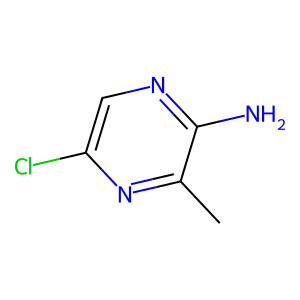
5-Chloro-3-methylpyrazin-2-amine
Names and Identifiers of 5-Chloro-3-methylpyrazin-2-amine
CAS Number |
1001050-30-1 |
|---|---|
MDL Number |
MFCD09881411 |
IUPAC Name |
5-chloro-3-methylpyrazin-2-amine |
InChI |
InChI=1S/C5H6ClN3/c1-3-5(7)8-2-4(6)9-3/h2H,1H3,(H2,7,8) |
InChIKey |
JQIRKTCPIIGFIK-UHFFFAOYSA-N |
Canonical SMILES |
CC1=NC(=CN=C1N)Cl |
UNSPSC Code |
12352100 |
Physical and chemical properties of 5-Chloro-3-methylpyrazin-2-amine
Acidity coefficient |
2.08±0.10(Predicted) |
|---|---|
Boiling Point |
276.4±35.0 °C(Predicted) |
Density |
1.349±0.06 g/cm3(Predicted) |
Exact Mass |
143.02500 |
LogP |
1.60180 |
Molecular Formula |
C5H6ClN3 |
Molecular Weight |
143.57400 |
PSA |
51.80000 |
Safety Information of 5-Chloro-3-methylpyrazin-2-amine

Applications of 5-Chloro-3-methylpyrazin-2-amine
5-Chloro-3-methylpyrazin-2-amine has potential applications in several fields:
- Pharmaceutical Development: Its unique structure may contribute to the development of new therapeutic agents targeting specific diseases.
- Agricultural Chemistry: The compound could be explored for use in agrochemicals due to its biological activity.
- Chemical Research: As an intermediate in organic synthesis, it may facilitate the production of more complex molecules.
Interaction Studies of 5-Chloro-3-methylpyrazin-2-amine
Interaction studies involving 5-Chloro-3-methylpyrazin-2-amine focus on its binding affinity with various biological targets. These studies are crucial for understanding the pharmacodynamics of the compound and optimizing its therapeutic potential. Variations in substituents on the pyrazine ring significantly affect interactions with enzymes or receptors, making this area a key focus for future research.
Biological Activity of 5-Chloro-3-methylpyrazin-2-amine
Research indicates that 5-Chloro-3-methylpyrazin-2-amine exhibits various biological activities. Preliminary studies suggest it may act as an inhibitor of certain enzymes and receptors, potentially influencing pathways related to immune responses and other physiological processes. The compound's ability to interact with biological macromolecules makes it a candidate for further pharmacological exploration.