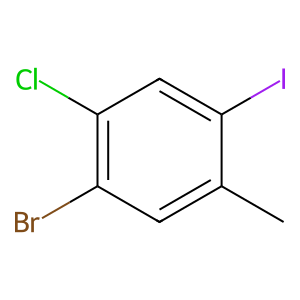
5-Bromo-4-chloro-2-iodotoluene
Names and Identifiers of 5-Bromo-4-chloro-2-iodotoluene
CAS Number |
1000578-03-9 |
|---|---|
MDL Number |
MFCD09800822 |
IUPAC Name |
1-bromo-2-chloro-4-iodo-5-methylbenzene |
InChI |
InChI=1S/C7H5BrClI/c1-4-2-5(8)6(9)3-7(4)10/h2-3H,1H3 |
InChIKey |
SEFKIVWHFWHXLG-UHFFFAOYSA-N |
Canonical SMILES |
CC1=CC(=C(C=C1I)Cl)Br |
UNSPSC Code |
12352100 |
Physical and chemical properties of 5-Bromo-4-chloro-2-iodotoluene
Exact Mass |
329.83100 |
|---|---|
LogP |
4.01550 |
Melting Point |
65 to 74°C |
Molecular Formula |
C7H5BrClI |
Molecular Weight |
331.37600 |
Safety Information of 5-Bromo-4-chloro-2-iodotoluene

Applications of 5-Bromo-4-chloro-2-iodotoluene
5-Bromo-4-chloro-2-iodotoluene finds applications across various fields:
- Organic Synthesis: It serves as a building block for synthesizing more complex organic molecules.
- Pharmaceutical Chemistry: Utilized in the development of pharmaceutical intermediates due to its reactivity.
- Material Science: Potentially used in creating functional materials through polymerization processes involving its reactive sites.
Interaction Studies of 5-Bromo-4-chloro-2-iodotoluene
Research indicates that 5-Bromo-4-chloro-2-iodotoluene interacts with multiple biological targets, influencing enzymatic functions and cellular mechanisms. For instance, it has been found to inhibit certain cytochrome P450 enzymes, affecting drug metabolism pathways. Such interactions underline its potential utility in pharmacological research and development.
Biological Activity of 5-Bromo-4-chloro-2-iodotoluene
The biological activity of 5-Bromo-4-chloro-2-iodotoluene has been explored in various studies. It has been shown to interact with several biochemical pathways and can influence cellular processes. Specifically, it has been noted for its ability to modulate enzyme activities and affect cell proliferation and differentiation through mechanisms such as enzyme inhibition or activation. Its interactions may also impact gene expression and cellular signaling pathways.