
5-Bromo-2-fluoro-1,3-dimethylbenzene
Names and Identifiers of 5-Bromo-2-fluoro-1,3-dimethylbenzene
CAS Number |
99725-44-7 |
|---|---|
EC Number |
671-133-5 |
MDL Number |
MFCD01320701 |
IUPAC Name |
5-bromo-2-fluoro-1,3-dimethylbenzene |
InChI |
InChI=1S/C8H8BrF/c1-5-3-7(9)4-6(2)8(5)10/h3-4H,1-2H3 |
InChIKey |
ZXPHUVHMBKRRJF-UHFFFAOYSA-N |
Canonical SMILES |
CC1=CC(=CC(=C1F)C)Br |
UNSPSC Code |
12352100 |
Physical and chemical properties of 5-Bromo-2-fluoro-1,3-dimethylbenzene
Boiling Point |
205.0±35.0 °C at 760 mmHg |
|---|---|
Density |
1.4±0.1 g/cm3 |
Exact Mass |
201.979340 |
Flash Point |
80.4±20.8 °C |
Index of Refraction |
1.524 |
LogP |
3.90 |
Molecular Formula |
C8H8BrF |
Molecular Weight |
203.051 |
Storage condition |
Sealed in dry,Room Temperature |
Vapour Pressure |
0.4±0.4 mmHg at 25°C |
Water Solubility |
Practically insoluble (0.018 g/L) (25 ºC) |
Safety Information of 5-Bromo-2-fluoro-1,3-dimethylbenzene

Applications of 5-Bromo-2-fluoro-1,3-dimethylbenzene
5-Bromo-2-fluoro-1,3-dimethylbenzene finds utility in various applications:
- Synthesis of Grignard Reagents: It serves as a precursor for preparing Grignard reagents.
- Aromatic Boron Compounds: The compound can also be utilized in synthesizing aromatic boron compounds.
- Cross-Coupling Reactions: Under transition metal catalysis, it participates in cross-coupling reactions to form polysubstituted fluorobenzenes.
Interaction Studies of 5-Bromo-2-fluoro-1,3-dimethylbenzene
Studies indicate that 5-Bromo-2-fluoro-1,3-dimethylbenzene interacts significantly with cytochrome P450 enzymes. This interaction may influence metabolic pathways for other compounds processed by these enzymes. Understanding these interactions is essential for assessing the compound's potential pharmacological effects and safety profile.
Biological Activity of 5-Bromo-2-fluoro-1,3-dimethylbenzene
5-Bromo-2-fluoro-1,3-dimethylbenzene exhibits notable biological activity. It has been shown to interact with cytochrome P450 enzymes, which play a crucial role in drug metabolism. The binding of this compound to these enzymes can lead to either inhibition or activation of their catalytic activities. Additionally, it is known to be practically insoluble in water but permeable through biological membranes.
Physical sample testing spectrum (NMR) of 5-Bromo-2-fluoro-1,3-dimethylbenzene

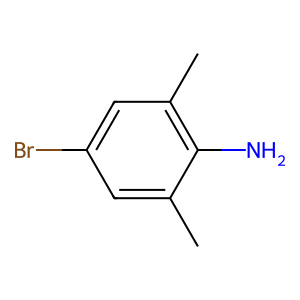 Cas:24596-19-8
