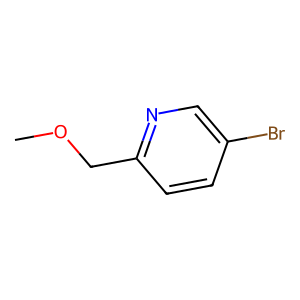
5-Bromo-2-(methoxymethyl)pyridine
CAS No.:
1000787-43-8
M. Wt:
202.04900
M. Fa:
C7H8BrNO
InChI Key:
LONDTBMHNVZMQD-UHFFFAOYSA-N
Appearance:
colorless to orange liquid
Names and Identifiers of 5-Bromo-2-(methoxymethyl)pyridine
CAS Number |
1000787-43-8 |
|---|---|
MDL Number |
MFCD18254265 |
IUPAC Name |
5-bromo-2-(methoxymethyl)pyridine |
InChI |
InChI=1S/C7H8BrNO/c1-10-5-7-3-2-6(8)4-9-7/h2-4H,5H2,1H3 |
InChIKey |
LONDTBMHNVZMQD-UHFFFAOYSA-N |
Canonical SMILES |
COCC1=NC=C(C=C1)Br |
UNSPSC Code |
12352100 |
Physical and chemical properties of 5-Bromo-2-(methoxymethyl)pyridine
Exact Mass |
200.97900 |
|---|---|
H Bond Acceptors |
2 |
H Bond Donors |
0 |
LogP |
1.99050 |
Molecular Formula |
C7H8BrNO |
Molecular Weight |
202.04900 |
PSA |
22.12000 |
Safety Information of 5-Bromo-2-(methoxymethyl)pyridine

Applications of 5-Bromo-2-(methoxymethyl)pyridine
5-Bromo-2-(methoxymethyl)pyridine finds applications primarily in:
- Pharmaceutical Development: Its derivatives are explored for their potential as therapeutic agents targeting neurotransmitter receptors.
- Organic Synthesis: Used as an intermediate in synthesizing more complex organic molecules.
- Material Science: Potential applications in developing new materials due to its unique structural properties.
Interaction Studies of 5-Bromo-2-(methoxymethyl)pyridine
Studies have indicated that 5-Bromo-2-(methoxymethyl)pyridine interacts with various biological targets, particularly neurotransmitter receptors. The binding affinity and specificity of its derivatives for dopamine and serotonin receptors are subjects of ongoing research, which could provide insights into their therapeutic potential.
Biological Activity of 5-Bromo-2-(methoxymethyl)pyridine
5-Bromo-2-(methoxymethyl)pyridine and its derivatives have shown potential biological activities. Notably, some derivatives act as antagonists for dopamine D2 and D3 receptors, as well as serotonin-3 receptors. This suggests that compounds in this class may have applications in treating neurological disorders.