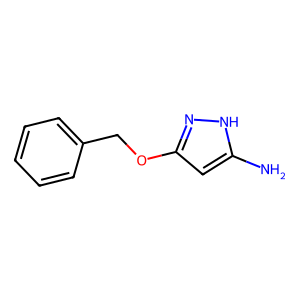
5-(benzyloxy)-1H-pyrazol-3-amine
Names and Identifiers of 5-(benzyloxy)-1H-pyrazol-3-amine
CAS Number |
1000896-40-1 |
|---|---|
EC Number |
850-626-0 |
MDL Number |
MFCD18205693 |
IUPAC Name |
3-phenylmethoxy-1H-pyrazol-5-amine |
InChI |
InChI=1S/C10H11N3O/c11-9-6-10(13-12-9)14-7-8-4-2-1-3-5-8/h1-6H,7H2,(H3,11,12,13) |
InChIKey |
DPMPAHAAODHNKV-UHFFFAOYSA-N |
Canonical SMILES |
C1=CC=C(C=C1)COC2=NNC(=C2)N |
UNSPSC Code |
12352100 |
Physical and chemical properties of 5-(benzyloxy)-1H-pyrazol-3-amine
Acidity coefficient |
14.08±0.10(Predicted) |
|---|---|
Boiling Point |
446.6±30.0 °C(Predicted) |
Density |
1.278±0.06 g/cm3(Predicted) |
Exact Mass |
189.09000 |
LogP |
2.15210 |
Molecular Formula |
C10H11N3O |
Molecular Weight |
189.21400 |
PSA |
63.93000 |
Storage condition |
under inert gas (nitrogen or Argon) at 2–8 °C |
Safety Information of 5-(benzyloxy)-1H-pyrazol-3-amine

Applications of 5-(benzyloxy)-1H-pyrazol-3-amine
5-(Benzyloxy)-1H-pyrazol-3-amine has various applications in:
- Pharmaceutical Development: It serves as a building block for synthesizing more complex molecules with potential therapeutic effects.
- Agrochemicals: The compound may be utilized in developing new agricultural chemicals.
- Specialty Chemicals: It finds use in producing dyes and other industrial products due to its unique chemical properties.
Interaction Studies of 5-(benzyloxy)-1H-pyrazol-3-amine
Studies on 5-(benzyloxy)-1H-pyrazol-3-amine have revealed its ability to interact with specific molecular targets. This interaction can modulate enzyme activity and receptor binding, leading to various biological effects. For instance, it may inhibit certain protein kinases involved in cell signaling pathways.
Biological Activity of 5-(benzyloxy)-1H-pyrazol-3-amine
5-(Benzyloxy)-1H-pyrazol-3-amine exhibits significant biological activity, making it a subject of interest in medicinal chemistry. It may act as an inhibitor for various enzymes and receptors, impacting cellular processes such as proliferation and survival. Its derivatives have been studied for potential therapeutic effects against different diseases, including cancer and inflammatory conditions.