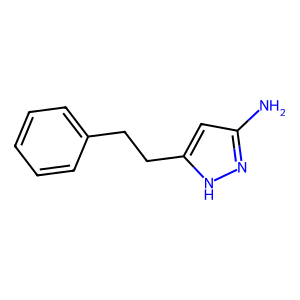
5-(2-Phenylethyl)-1H-pyrazol-3-amine
CAS No.:
1000895-40-8
M. Wt:
187.24100
M. Fa:
C11H13N3
InChI Key:
XRFRSAFQLGCWFY-UHFFFAOYSA-N
Appearance:
Solid
Names and Identifiers of 5-(2-Phenylethyl)-1H-pyrazol-3-amine
CAS Number |
1000895-40-8 |
|---|---|
EC Number |
823-236-3 |
MDL Number |
MFCD10689450 |
IUPAC Name |
5-(2-phenylethyl)-1H-pyrazol-3-amine |
InChI |
InChI=1S/C11H13N3/c12-11-8-10(13-14-11)7-6-9-4-2-1-3-5-9/h1-5,8H,6-7H2,(H3,12,13,14) |
InChIKey |
XRFRSAFQLGCWFY-UHFFFAOYSA-N |
Canonical SMILES |
C1=CC=C(C=C1)CCC2=CC(=NN2)N |
UNSPSC Code |
12352100 |
Physical and chemical properties of 5-(2-Phenylethyl)-1H-pyrazol-3-amine
Exact Mass |
187.11100 |
|---|---|
LogP |
1.70720 |
Molecular Formula |
C11H13N3 |
Molecular Weight |
187.24100 |
PSA |
55.43000 |
Safety Information of 5-(2-Phenylethyl)-1H-pyrazol-3-amine

Applications of 5-(2-Phenylethyl)-1H-pyrazol-3-amine
5-(2-Phenylethyl)-1H-pyrazol-3-amine has potential applications in various fields:
- Medicinal Chemistry: As a scaffold for developing new therapeutic agents.
- Material Science: In the production of specialty chemicals and materials due to its unique structure.
- Research: As a building block for synthesizing more complex molecules.
Interaction Studies of 5-(2-Phenylethyl)-1H-pyrazol-3-amine
Interaction studies involving similar compounds suggest that pyrazoles can engage in hydrogen bonding and electrostatic interactions with biological macromolecules. This characteristic is crucial for their potential use as drug candidates, influencing their binding affinity and specificity toward various targets.