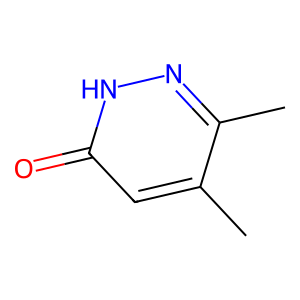
5,6-dimethylpyridazin-3(2H)-one
Names and Identifiers of 5,6-dimethylpyridazin-3(2H)-one
CAS Number |
100114-19-0 |
|---|---|
MDL Number |
MFCD20502909 |
IUPAC Name |
3,4-dimethyl-1H-pyridazin-6-one |
InChI |
InChI=1S/C6H8N2O/c1-4-3-6(9)8-7-5(4)2/h3H,1-2H3,(H,8,9) |
InChIKey |
AWPAHXPYSVABCQ-UHFFFAOYSA-N |
Canonical SMILES |
CC1=CC(=O)NN=C1C |
UNSPSC Code |
12352100 |
Physical and chemical properties of 5,6-dimethylpyridazin-3(2H)-one
Exact Mass |
124.06400 |
|---|---|
LogP |
0.38670 |
Molecular Formula |
C6H8N2O |
Molecular Weight |
124.14100 |
PSA |
45.75000 |
Safety Information of 5,6-dimethylpyridazin-3(2H)-one

Applications of 5,6-dimethylpyridazin-3(2H)-one
5,6-Dimethylpyridazin-3(2H)-one has several applications:
- Pharmaceuticals: Its derivatives are being explored for their potential as therapeutic agents, particularly in oncology.
- Chemical Intermediates: It serves as an intermediate in the synthesis of more complex organic compounds.
- Research Tools: Due to its unique structure, it is used in various studies exploring chemical reactivity and biological interactions.
Interaction Studies of 5,6-dimethylpyridazin-3(2H)-one
Interaction studies have shown that 5,6-dimethylpyridazin-3(2H)-one can form complexes with various biological molecules. Its ability to act as a ligand makes it useful in studying enzyme inhibition mechanisms and receptor binding affinities. These interactions are crucial for understanding its potential therapeutic effects.
Biological Activity of 5,6-dimethylpyridazin-3(2H)-one
Research indicates that derivatives of 5,6-dimethylpyridazin-3(2H)-one exhibit significant biological activities. Specifically, some studies have identified its potential as an inhibitor of poly(ADP-ribose) polymerase, which is relevant in cancer therapy. This compound's structural features allow it to interact with biological targets effectively, making it a candidate for pharmaceutical development.