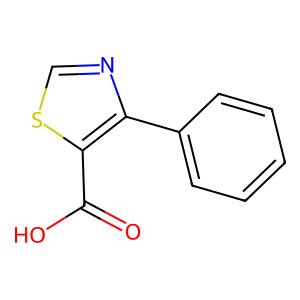
4-Phenylthiazole-5-carboxylic acid
Names and Identifiers of 4-Phenylthiazole-5-carboxylic acid
CAS Number |
99822-84-1 |
|---|---|
IUPAC Name |
4-phenyl-1,3-thiazole-5-carboxylic acid |
InChI |
InChI=1S/C10H7NO2S/c12-10(13)9-8(11-6-14-9)7-4-2-1-3-5-7/h1-6H,(H,12,13) |
InChIKey |
NGTZFWMOTDGMKO-UHFFFAOYSA-N |
Canonical SMILES |
C1=CC=C(C=C1)C2=C(SC=N2)C(=O)O |
Physical and chemical properties of 4-Phenylthiazole-5-carboxylic acid
Exact Mass |
205.02000 |
|---|---|
LogP |
2.50830 |
Molecular Formula |
C10H7NO2S |
Molecular Weight |
205.23300 |
PSA |
78.43000 |
Safety Information of 4-Phenylthiazole-5-carboxylic acid

Applications of 4-Phenylthiazole-5-carboxylic acid
4-Phenylthiazole-5-carboxylic acid has several applications in medicinal chemistry:
- Drug Development: Its potential as an antiviral agent makes it a subject of interest for developing new antiviral therapies.
- Biochemical Research: It serves as a tool for studying enzyme inhibition and other biochemical pathways.
- Agricultural Chemistry: Similar compounds have been explored for use as agrochemicals, indicating potential applications in pest control.
Interaction Studies of 4-Phenylthiazole-5-carboxylic acid
Interaction studies have focused on understanding how 4-phenylthiazole-5-carboxylic acid interacts with biological macromolecules, such as proteins and nucleic acids. These studies are crucial for elucidating its mechanism of action as an antiviral agent. For example, structural optimization based on molecular docking studies has been employed to predict binding affinities and interactions with viral proteins. Such insights are essential for guiding further modifications to enhance efficacy and selectivity.
Biological Activity of 4-Phenylthiazole-5-carboxylic acid
Studies have indicated that 4-phenylthiazole-5-carboxylic acid exhibits notable biological activities, particularly as an antiflaviviral agent. Research has shown that modifications on the phenyl ring can significantly influence the compound's effectiveness against flavivirus infections. For instance, derivatives of this compound have been evaluated for their ability to inhibit viral replication, showcasing promising results in vitro. Additionally, its structural characteristics allow it to interact with various biological targets, making it a candidate for further pharmacological exploration.
Physical sample testing spectrum (NMR) of 4-Phenylthiazole-5-carboxylic acid

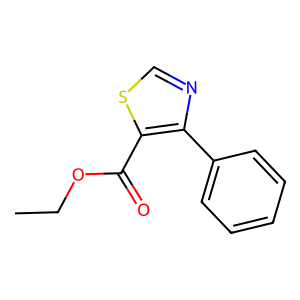 Cas:99822-80-7

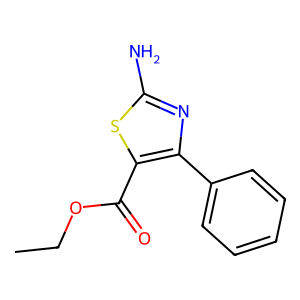 Cas:64399-23-1
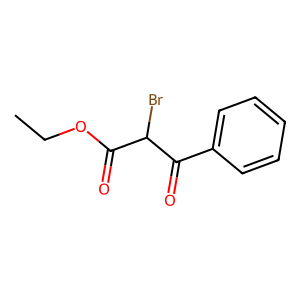 Cas:55919-47-6