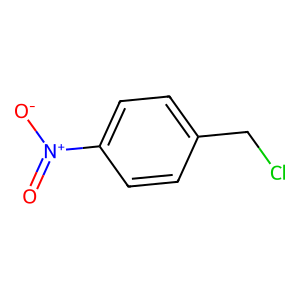
4-Nitrobenzyl chloride
Names and Identifiers of 4-Nitrobenzyl chloride
CAS Number |
100-14-1 |
|---|---|
EC Number |
202-822-7 |
MDL Number |
MFCD00007374 |
IUPAC Name |
1-(chloromethyl)-4-nitrobenzene |
InChI |
InChI=1S/C7H6ClNO2/c8-5-6-1-3-7(4-2-6)9(10)11/h1-4H,5H2 |
InChIKey |
KGCNHWXDPDPSBV-UHFFFAOYSA-N |
Canonical SMILES |
C1=CC(=CC=C1CCl)[N+](=O)[O-] |
UNII |
3BLD9LVT3X |
UNSPSC Code |
12352100 |
Physical and chemical properties of 4-Nitrobenzyl chloride
Boiling Point |
292.5±15.0 °C at 760 mmHg |
|---|---|
Density |
1.5647 (NTP, 1992) |
Exact Mass |
171.008713 |
Flash Point |
130.7±20.4 °C |
Index of Refraction |
Index of refraction: 1.5647 at 62 °C |
LogP |
2.22 |
Melting Point |
71 °C |
Molecular Formula |
C7H6ClNO2 |
Molecular Weight |
171.581 |
PSA |
45.82000 |
Solubility |
Sol in alcohol, ether, acetone, benzene |
Stability |
Stable. Incompatible with strong oxidizing agents, bases, amines, moisture, alcohols. Corrodes steel. Reacts slowly with water. Combustible. |
Vapour Pressure |
0.0±0.6 mmHg at 25°C |
Safety Information of 4-Nitrobenzyl chloride

Applications of 4-Nitrobenzyl chloride
4-Nitrobenzyl chloride has various applications in chemical synthesis and industrial processes:
- Intermediate in Organic Synthesis: It serves as a key intermediate in the synthesis of pharmaceuticals, agrochemicals, and dyes.
- Precursor for Functionalized Compounds: The compound is used to create more complex molecules through nucleophilic substitution reactions.
- Research Tool: It is utilized in laboratories for studying reaction mechanisms involving nucleophiles and electrophiles.
Interaction Studies of 4-Nitrobenzyl chloride
Studies on the interactions of 4-nitrobenzyl chloride with biological systems have revealed its potential effects on enzyme activity. For instance, research has shown that it can influence the reactivity of certain enzymes through its electrophilic nature, which may lead to modifications in enzyme kinetics and substrate specificity. Further exploration into its interactions with proteins and other biomolecules could provide insights into its biological roles.
Biological Activity of 4-Nitrobenzyl chloride
Research indicates that 4-nitrobenzyl chloride exhibits biological activities that can influence various biochemical pathways. It has been studied for its potential effects on enzyme activity and as a precursor in synthesizing biologically active compounds. Some studies suggest that derivatives of 4-nitrobenzyl chloride may possess antimicrobial properties, although further research is required to fully understand its biological implications.
Physical sample testing spectrum (NMR) of 4-Nitrobenzyl chloride

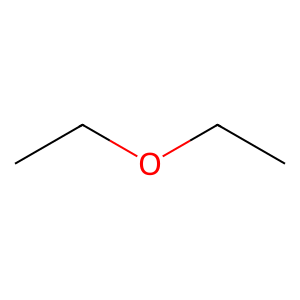 Cas:60-29-7

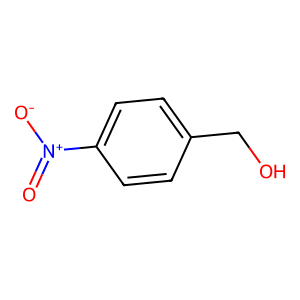 Cas:619-73-8
 Cas:66650-27-9

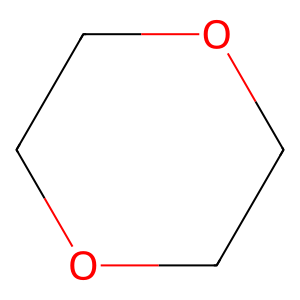 Cas:123-91-1
 Cas:500-11-8
 Cas:7647-01-0