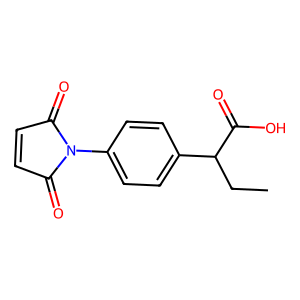
4-N-Maleimidophenyl butanoic acid
Names and Identifiers of 4-N-Maleimidophenyl butanoic acid
CAS Number |
100072-54-6 |
|---|---|
IUPAC Name |
2-[4-[2,5-bis(oxidanylidene)pyrrol-1-yl]phenyl]butanoic acid |
Canonical SMILES |
CCC(C1=CC=C(C=C1)N2C(=O)C=CC2=O)C(=O)O |
Physical and chemical properties of 4-N-Maleimidophenyl butanoic acid
Acidity coefficient |
4.73±0.10(Predicted) |
|---|---|
Boiling Point |
456.194ºC at 760 mmHg |
Density |
1.354 g/cm3 |
Exact Mass |
259.08400 |
Flash Point |
229.698ºC |
LogP |
1.75920 |
Molecular Formula |
C14H13NO4 |
Molecular Weight |
259.25700 |
PSA |
74.68000 |
Applications of 4-N-Maleimidophenyl butanoic acid
4-N-Maleimidophenyl butanoic acid finds applications across various fields:
- Bioconjugation: It is widely used for conjugating proteins, antibodies, and other biomolecules due to its selective reactivity with thiols.
- Drug Delivery: The compound can be utilized in creating targeted drug delivery systems that release therapeutic agents at specific sites within the body.
- Diagnostics: It plays a role in developing assays and sensors that detect specific biomolecules through covalent bonding.
- Research Tools: In biochemical research, it serves as a cross-linker for studying protein interactions and dynamics in cellular environments.
Interaction Studies of 4-N-Maleimidophenyl butanoic acid
Studies on the interactions of 4-N-Maleimidophenyl butanoic acid with various biomolecules reveal its potential as a versatile tool in biochemical research. For instance, it has been employed to explore protein-protein interactions by labeling proteins with fluorescent tags via maleimide-thiol chemistry. This approach allows researchers to visualize and quantify interactions within living cells or in vitro systems.
Additionally, interaction studies have indicated that this compound can enhance the stability and functionality of conjugated proteins, which is critical for therapeutic applications.
Biological Activity of 4-N-Maleimidophenyl butanoic acid
4-N-Maleimidophenyl butanoic acid exhibits significant biological activity due to its ability to selectively bind to thiol-containing biomolecules. This property allows it to be used in the development of targeted drug delivery systems and as a tool for studying protein interactions. Research has shown that compounds containing maleimide groups can influence cellular processes by modifying protein functions, thereby impacting cell signaling pathways and responses to stimuli.