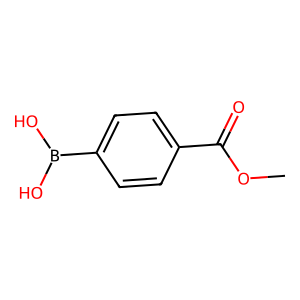
4-Methoxycarbonylphenylboronic acid
Names and Identifiers of 4-Methoxycarbonylphenylboronic acid
CAS Number |
99768-12-4 |
|---|---|
EC Number |
619-459-9 |
MDL Number |
MFCD01632203 |
IUPAC Name |
(4-methoxycarbonylphenyl)boronic acid |
InChI |
InChI=1S/C8H9BO4/c1-13-8(10)6-2-4-7(5-3-6)9(11)12/h2-5,11-12H,1H3 |
InChIKey |
PQCXFUXRTRESBD-UHFFFAOYSA-N |
Canonical SMILES |
B(C1=CC=C(C=C1)C(=O)OC)(O)O |
UNSPSC Code |
12352100 |
Physical and chemical properties of 4-Methoxycarbonylphenylboronic acid
Boiling Point |
345.8±44.0 °C at 760 mmHg |
|---|---|
Density |
1.3±0.1 g/cm3 |
Exact Mass |
180.059387 |
Flash Point |
162.9±28.4 °C |
Index of Refraction |
1.533 |
LogP |
1.57 |
Melting Point |
197-200 °C(lit.) |
Molecular Formula |
C8H9BO4 |
Molecular Weight |
179.97 |
PSA |
66.76000 |
Storage condition |
0-6°C |
Vapour Pressure |
0.0±0.8 mmHg at 25°C |
Safety Information of 4-Methoxycarbonylphenylboronic acid

Applications of 4-Methoxycarbonylphenylboronic acid
4-Methoxycarbonylphenylboronic acid finds applications across various fields:
- Pharmaceuticals: It is used in the synthesis of biologically active compounds, including potential drug candidates for treating HIV and other diseases.
- Organic Synthesis: This compound is essential in developing complex organic molecules through cross-coupling reactions.
- Material Science: It may also play a role in creating new materials with specific electronic or optical properties.
Interaction Studies of 4-Methoxycarbonylphenylboronic acid
Studies have indicated that 4-methoxycarbonylphenylboronic acid can interact with biological systems, particularly through its role as an inhibitor of quorum sensing in bacteria like Vibrio harveyi. This interaction suggests potential applications in developing antimicrobial agents by disrupting bacterial communication systems.
Biological Activity of 4-Methoxycarbonylphenylboronic acid
The biological activity of 4-methoxycarbonylphenylboronic acid has been studied primarily in the context of its potential as an inhibitor for certain enzymatic activities. For example, it has been investigated for its ability to inhibit intracellular N-acylethanolamine acid amidase, which may have implications for pain management and inflammation control. Additionally, it has shown promise in the design of compounds targeting HIV maturation processes.
Physical sample testing spectrum (NMR) of 4-Methoxycarbonylphenylboronic acid

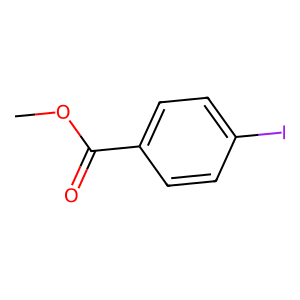 Cas:619-44-3

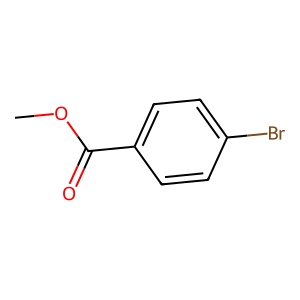 Cas:619-42-1
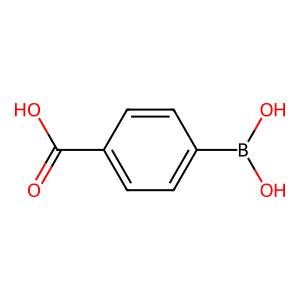 Cas:14047-29-1