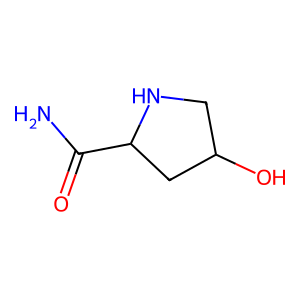
4-Hydroxypyrrolidine-2-carboxamide
Names and Identifiers of 4-Hydroxypyrrolidine-2-carboxamide
CAS Number |
1000616-27-2 |
|---|---|
MDL Number |
MFCD04635892 |
IUPAC Name |
4-hydroxypyrrolidine-2-carboxamide |
InChI |
InChI=1S/C5H10N2O2/c6-5(9)4-1-3(8)2-7-4/h3-4,7-8H,1-2H2,(H2,6,9) |
InChIKey |
OJSXAYGYRGXDSQ-UHFFFAOYSA-N |
Canonical SMILES |
C1C(CNC1C(=O)N)O |
UNSPSC Code |
12352100 |
Physical and chemical properties of 4-Hydroxypyrrolidine-2-carboxamide
H Bond Acceptors |
3 |
|---|---|
H Bond Donors |
3 |
LogP |
-2.05178163566667 |
Molecular Formula |
C5H10N2O2 |
Molecular Weight |
130.15 |
Safety Information of 4-Hydroxypyrrolidine-2-carboxamide

Applications of 4-Hydroxypyrrolidine-2-carboxamide
4-Hydroxypyrrolidine-2-carboxamide has diverse applications across various fields:
- Chemistry: It serves as a chiral building block in synthesizing complex organic molecules.
- Biology: It is utilized in studies involving enzyme mechanisms and protein-ligand interactions.
- Medicine: This compound acts as an intermediate in synthesizing pharmaceuticals, including antiviral and anticancer agents.
- Industry: It finds use in producing agrochemicals and other fine chemicals.
Interaction Studies of 4-Hydroxypyrrolidine-2-carboxamide
Research into the interaction of 4-Hydroxypyrrolidine-2-carboxamide with biological targets has revealed its potential as a modulator of enzyme activity. Studies indicate that the compound can inhibit or activate specific enzymes, leading to therapeutic effects. The presence of functional groups such as hydroxyl and amide enhances its ability to bind to active sites on enzymes, facilitating changes in their activity.
Biological Activity of 4-Hydroxypyrrolidine-2-carboxamide
The biological activity of 4-Hydroxypyrrolidine-2-carboxamide is significant due to its interaction with specific molecular targets such as enzymes and receptors. This compound has been studied for its potential roles as an enzyme inhibitor or modulator, affecting various biochemical pathways. Its stereochemistry plays a crucial role in its binding affinity, making it valuable in the development of therapeutics targeting neurological and cardiovascular diseases.