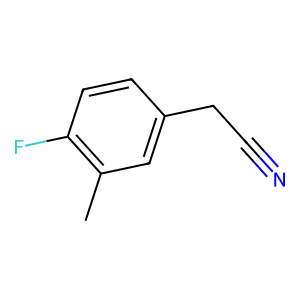
4-Fluoro-3-methylphenylacetonitrile
Names and Identifiers of 4-Fluoro-3-methylphenylacetonitrile
CAS Number |
1000548-41-3 |
|---|---|
MDL Number |
MFCD09832240 |
IUPAC Name |
2-(4-fluoro-3-methylphenyl)acetonitrile |
InChI |
InChI=1S/C9H8FN/c1-7-6-8(4-5-11)2-3-9(7)10/h2-3,6H,4H2,1H3 |
InChIKey |
XAVNYICMRHFCLO-UHFFFAOYSA-N |
Canonical SMILES |
CC1=C(C=CC(=C1)CC#N)F |
UNSPSC Code |
12352100 |
Physical and chemical properties of 4-Fluoro-3-methylphenylacetonitrile
Exact Mass |
149.06400 |
|---|---|
LogP |
2.20018 |
Molecular Formula |
C9H8FN |
Molecular Weight |
149.16500 |
PSA |
23.79000 |
Safety Information of 4-Fluoro-3-methylphenylacetonitrile

Applications of 4-Fluoro-3-methylphenylacetonitrile
4-Fluoro-3-methylphenylacetonitrile has several applications:
- Chemistry: It serves as an intermediate in synthesizing pharmaceuticals and agrochemicals.
- Biology: Used in studies of enzyme inhibition and receptor binding due to its structural properties.
- Medicine: Explored for developing drugs targeting specific biological pathways.
- Industry: Utilized in producing specialty chemicals and materials with unique properties.
Interaction Studies of 4-Fluoro-3-methylphenylacetonitrile
Interaction studies surrounding 4-Fluoro-3-methylphenylacetonitrile focus on its binding mechanisms with enzymes and receptors. The unique properties imparted by the fluorine atom enhance its potential as a lead compound in drug design, where understanding these interactions is crucial for optimizing pharmacological profiles. Research continues to explore how this compound interacts with various molecular targets within biological systems.
Similar Compounds: ComparisonSeveral compounds share structural similarities with 4-Fluoro-3-methylphenylacetonitrile, including:
| Compound Name | Molecular Formula | Unique Features |
|---|---|---|
| 4-Fluorobenzyl cyanide | C8H8FN | Lacks methyl group; affects reactivity |
| 3-Methylbenzyl cyanide | C9H9N | Lacks fluorine atom at the para position |
| 4-Fluoro-3-methylbenzyl alcohol | C9H11FO | Contains hydroxyl group instead of nitrile |
| 2-(Trifluoromethyl)phenylacetonitrile | C9H7F3N | Different position of trifluoromethyl substitution |
Biological Activity of 4-Fluoro-3-methylphenylacetonitrile
Research indicates that 4-Fluoro-3-methylphenylacetonitrile may exhibit significant biological activity. Its structural characteristics allow it to interact with various biomolecules, influencing enzyme activity and receptor binding. The presence of fluorine enhances its binding affinity to certain biological targets, which is crucial in drug development contexts. Studies have explored its potential as a lead compound in pharmacological research due to these interactions.