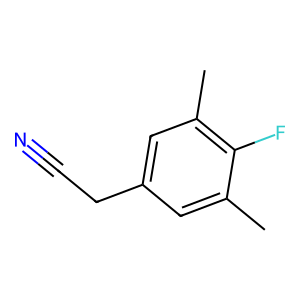
4-Fluoro-3,5-dimethylphenylacetonitrile
CAS No.:
1000513-61-0
M. Wt:
163.19
M. Fa:
C10H10FN
InChI Key:
DYKROXSOTOZSPT-UHFFFAOYSA-N
Appearance:
Liquid
Names and Identifiers of 4-Fluoro-3,5-dimethylphenylacetonitrile
CAS Number |
1000513-61-0 |
|---|---|
MDL Number |
MFCD09832374 |
IUPAC Name |
2-(4-fluoro-3,5-dimethylphenyl)acetonitrile |
InChI |
InChI=1S/C10H10FN/c1-7-5-9(3-4-12)6-8(2)10(7)11/h5-6H,3H2,1-2H3 |
InChIKey |
DYKROXSOTOZSPT-UHFFFAOYSA-N |
Canonical SMILES |
CC1=CC(=CC(=C1F)C)CC#N |
UNSPSC Code |
12352100 |
Physical and chemical properties of 4-Fluoro-3,5-dimethylphenylacetonitrile
Boiling Point |
258.1±35.0 °C(Predicted) |
|---|---|
Density |
1.070±0.06 g/cm3(Predicted) |
Molecular Formula |
C10H10FN |
Molecular Weight |
163.19 |
Applications of 4-Fluoro-3,5-dimethylphenylacetonitrile
4-Fluoro-3,5-dimethylphenylacetonitrile has several notable applications:
- Pharmaceutical Intermediates: It serves as a building block in the synthesis of pharmaceutical compounds due to its functional groups.
- Organic Synthesis: Its reactivity allows it to be used in creating more complex organic molecules.
- Material Science: Potential uses in developing new materials with specific electronic or optical properties have been explored.
Interaction Studies of 4-Fluoro-3,5-dimethylphenylacetonitrile
Studies on interaction profiles reveal that 4-Fluoro-3,5-dimethylphenylacetonitrile may interact with various biological targets. For instance:
- Drug Metabolism: As a potential inhibitor of cytochrome P450 enzymes, it could affect the metabolism of co-administered drugs.
- Binding Studies: Investigations into how this compound binds to receptor sites could provide insights into its pharmacological potential.
Such studies are essential for understanding the safety and efficacy of compounds before they can be considered for therapeutic use.