
4-Chloropyridine-2-carboxamide
Names and Identifiers of 4-Chloropyridine-2-carboxamide
CAS Number |
99586-65-9 |
|---|---|
EC Number |
808-030-3 |
MDL Number |
MFCD01085339 |
IUPAC Name |
4-chloropyridine-2-carboxamide |
InChI |
InChI=1S/C6H5ClN2O/c7-4-1-2-9-5(3-4)6(8)10/h1-3H,(H2,8,10) |
InChIKey |
XIHHOUUTBZSYJH-UHFFFAOYSA-N |
Canonical SMILES |
C1=CN=C(C=C1Cl)C(=O)N |
UNSPSC Code |
12352100 |
Physical and chemical properties of 4-Chloropyridine-2-carboxamide
Acidity coefficient |
14.49±0.50(Predicted) |
|---|---|
Boiling Point |
298.1±25.0 °C at 760 mmHg |
Density |
1.4±0.1 g/cm3 |
Exact Mass |
156.009033 |
Flash Point |
134.1±23.2 °C |
Index of Refraction |
1.589 |
LogP |
0.62 |
Melting Point |
148-152 |
Molecular Formula |
C6H5ClN2O |
Molecular Weight |
156.570 |
PSA |
55.98000 |
Storage condition |
under inert gas (nitrogen or Argon) at 2-8°C |
Vapour Pressure |
0.0±0.6 mmHg at 25°C |
λmax |
268nm(EtOH)(lit.) |
Safety Information of 4-Chloropyridine-2-carboxamide

Applications of 4-Chloropyridine-2-carboxamide
4-Chloropyridine-2-carboxamide finds applications in various fields:
- Pharmaceuticals: It serves as an intermediate in the synthesis of various drugs due to its ability to modify biological activity.
- Agrochemicals: Utilized in the development of pesticides and herbicides.
- Material Science: Employed in creating novel materials with specific electronic or optical properties .
Interaction Studies of 4-Chloropyridine-2-carboxamide
Interaction studies of 4-Chloropyridine-2-carboxamide have revealed its potential binding affinity for several biological targets. These studies often employ techniques such as molecular docking and binding assays to evaluate how this compound interacts with enzymes or receptors. Its unique structure allows it to fit into active sites, potentially leading to inhibition or modulation of biological pathways .
Biological Activity of 4-Chloropyridine-2-carboxamide
Research indicates that 4-Chloropyridine-2-carboxamide exhibits significant biological activity. It has been studied for its potential as an antimicrobial agent and may also possess anti-inflammatory properties. The presence of the chloropyridine moiety is believed to enhance its interaction with biological targets, making it a candidate for further pharmacological studies .
Physical sample testing spectrum (NMR) of 4-Chloropyridine-2-carboxamide

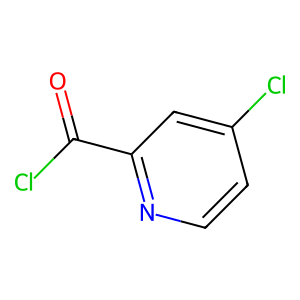 Cas:53750-66-6

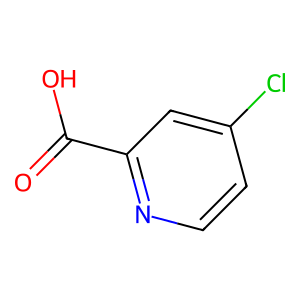 Cas:5470-22-4
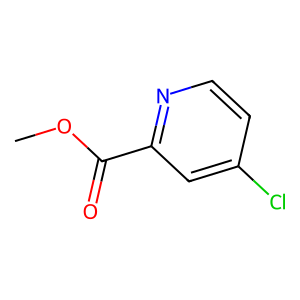 Cas:24484-93-3

 Cas:7664-41-7