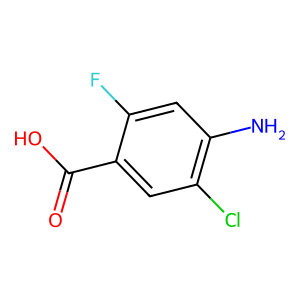
4-Amino-5-chloro-2-fluorobenzoic acid
Names and Identifiers of 4-Amino-5-chloro-2-fluorobenzoic acid
CAS Number |
1001346-86-6 |
|---|---|
EC Number |
834-887-8 |
IUPAC Name |
4-amino-5-chloro-2-fluorobenzoic acid |
InChI |
InChI=1S/C7H5ClFNO2/c8-4-1-3(7(11)12)5(9)2-6(4)10/h1-2H,10H2,(H,11,12) |
InChIKey |
UBVUOMYWOMBBGJ-UHFFFAOYSA-N |
Canonical SMILES |
C1=C(C(=CC(=C1Cl)N)F)C(=O)O |
Physical and chemical properties of 4-Amino-5-chloro-2-fluorobenzoic acid
Acidity coefficient |
3.56±0.10(Predicted) |
|---|---|
Boiling Point |
336.9±42.0 °C(Predicted) |
Density |
1.574±0.06 g/cm3(Predicted) |
Exact Mass |
188.99900 |
LogP |
2.34070 |
Molecular Formula |
C7H5ClFNO2 |
Molecular Weight |
189.57200 |
PSA |
63.32000 |
Safety Information of 4-Amino-5-chloro-2-fluorobenzoic acid

Applications of 4-Amino-5-chloro-2-fluorobenzoic acid
4-Amino-5-chloro-2-fluorobenzoic acid has several applications:
- Pharmaceutical Intermediates: It serves as an important intermediate in the synthesis of various drugs, particularly those targeting inflammatory pathways.
- Organic Synthesis: The compound is utilized in organic synthesis for creating more complex molecules due to its reactive functional groups.
- Research
Interaction Studies of 4-Amino-5-chloro-2-fluorobenzoic acid
Studies have indicated that 4-amino-5-chloro-2-fluorobenzoic acid interacts with specific enzymes and receptors, modulating various biochemical pathways. Its unique structure allows it to act as an enzyme inhibitor by binding to active sites, thereby blocking enzymatic activity. Additionally, it may influence signal transduction pathways through receptor binding, making it significant in pharmacological research.
Biological Activity of 4-Amino-5-chloro-2-fluorobenzoic acid
4-Amino-5-chloro-2-fluorobenzoic acid exhibits potential biological activity attributed to its structural features. It has been studied for its role as an intermediate in pharmaceuticals, particularly in the development of anti-inflammatory and analgesic agents. The compound's ability to interact with various biological targets makes it a candidate for further research in drug development, especially concerning enzyme inhibition and receptor binding.