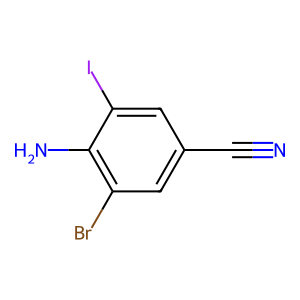
4-Amino-3-bromo-5-iodobenzonitrile
Names and Identifiers of 4-Amino-3-bromo-5-iodobenzonitrile
CAS Number |
1000578-00-6 |
|---|---|
MDL Number |
MFCD09800820 |
IUPAC Name |
4-amino-3-bromo-5-iodobenzonitrile |
InChI |
InChI=1S/C7H4BrIN2/c8-5-1-4(3-10)2-6(9)7(5)11/h1-2H,11H2 |
InChIKey |
ZXCXPHSSIDEPDP-UHFFFAOYSA-N |
Canonical SMILES |
N#CC1=CC(Br)=C(N)C(I)=C1 |
UNSPSC Code |
12352100 |
Physical and chemical properties of 4-Amino-3-bromo-5-iodobenzonitrile
Exact Mass |
321.86000 |
|---|---|
LogP |
3.08878 |
Melting Point |
157 to 160°C |
Molecular Formula |
C7H4BrIN2 |
Molecular Weight |
322.92900 |
PSA |
49.81000 |
Safety Information of 4-Amino-3-bromo-5-iodobenzonitrile

Applications of 4-Amino-3-bromo-5-iodobenzonitrile
4-Amino-3-bromo-5-iodobenzonitrile has several significant applications:
- Organic Synthesis: It serves as a versatile building block for synthesizing more complex organic molecules.
- Medicinal Chemistry: Its role as an intermediate in drug development is critical, particularly in designing compounds with specific biological activities.
- Material Science: The compound is also utilized in the synthesis of heterocycles and liquid crystals, which are important for electronic applications.
Interaction Studies of 4-Amino-3-bromo-5-iodobenzonitrile
Research on 4-Amino-3-bromo-5-iodobenzonitrile has indicated its potential interactions with various biomolecules. Studies focusing on its inhibitory effects on cytochrome P450 enzymes suggest that it may alter the metabolism of co-administered drugs. Such interactions are essential for understanding its pharmacokinetics and potential side effects when used therapeutically.
Biological Activity of 4-Amino-3-bromo-5-iodobenzonitrile
4-Amino-3-bromo-5-iodobenzonitrile exhibits notable biological activities that make it relevant in pharmaceutical research. It has been identified as a potential inhibitor of certain cytochrome P450 enzymes, which are crucial for drug metabolism. Specifically, it has shown inhibitory effects on CYP1A2 and CYP2C9, indicating its potential role in drug-drug interactions. Furthermore, its structural characteristics may enable it to interact with various biological targets, making it a candidate for further investigation in drug development.