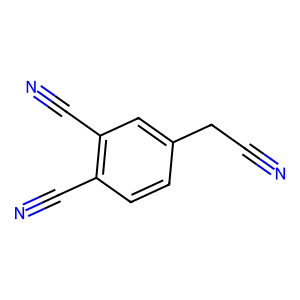
4-(Cyanomethyl)phthalonitrile
CAS No.:
1000540-60-2
M. Wt:
167.167
M. Fa:
C10H5N3
InChI Key:
DNTJEZLMBRPHMI-UHFFFAOYSA-N
Appearance:
Gray Solid
Names and Identifiers of 4-(Cyanomethyl)phthalonitrile
CAS Number |
1000540-60-2 |
|---|---|
MDL Number |
MFCD09923935 |
IUPAC Name |
4-(cyanomethyl)benzene-1,2-dicarbonitrile |
InChI |
InChI=1S/C10H5N3/c11-4-3-8-1-2-9(6-12)10(5-8)7-13/h1-2,5H,3H2 |
InChIKey |
DNTJEZLMBRPHMI-UHFFFAOYSA-N |
Canonical SMILES |
C1=CC(=C(C=C1CC#N)C#N)C#N |
UNSPSC Code |
12352100 |
Physical and chemical properties of 4-(Cyanomethyl)phthalonitrile
Boiling Point |
418.0±40.0 °C at 760 mmHg |
|---|---|
Density |
1.2±0.1 g/cm3 |
Exact Mass |
167.048340 |
Flash Point |
218.1±21.2 °C |
Index of Refraction |
1.575 |
LogP |
0.30 |
Molecular Formula |
C10H5N3 |
Molecular Weight |
167.167 |
Storage condition |
Sealed in dry,Room Temperature |
Vapour Pressure |
0.0±1.0 mmHg at 25°C |
Safety Information of 4-(Cyanomethyl)phthalonitrile

Applications of 4-(Cyanomethyl)phthalonitrile
4-(Cyanomethyl)phthalonitrile has several potential applications:
- Material Science: It can be utilized as a precursor for the synthesis of phthalocyanine dyes and pigments, which are known for their stability and vivid colors.
- Organic Electronics: The compound may serve as an intermediate in the production of organic semiconductors and photovoltaic materials.
- Pharmaceuticals: Its derivatives could be explored for their potential therapeutic properties, particularly in drug design.
Interaction Studies of 4-(Cyanomethyl)phthalonitrile
Interaction studies involving 4-(Cyanomethyl)phthalonitrile are essential to understand its reactivity and potential biological effects. Research indicates that compounds with similar structures can interact with various enzymes and receptors, influencing biological pathways. Investigating these interactions could provide insights into the compound's pharmacological potential and guide future research directions.