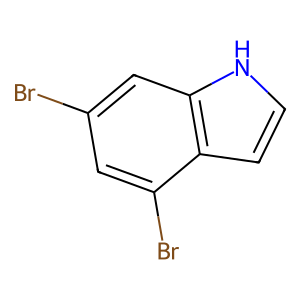
4,6-dibromo-1H-indole
CAS No.:
99910-50-6
M. Wt:
274.940
M. Fa:
C8H5Br2N
InChI Key:
PXUDJVIHHHIEGO-UHFFFAOYSA-N
Appearance:
Yellow Solid
Names and Identifiers of 4,6-dibromo-1H-indole
CAS Number |
99910-50-6 |
|---|---|
MDL Number |
MFCD07357291 |
IUPAC Name |
4,6-dibromo-1H-indole |
InChI |
InChI=1S/C8H5Br2N/c9-5-3-7(10)6-1-2-11-8(6)4-5/h1-4,11H |
InChIKey |
PXUDJVIHHHIEGO-UHFFFAOYSA-N |
Canonical SMILES |
C1=CNC2=C1C(=CC(=C2)Br)Br |
UNSPSC Code |
12352100 |
Physical and chemical properties of 4,6-dibromo-1H-indole
Acidity coefficient |
15.14±0.30(Predicted) |
|---|---|
Boiling Point |
368.5±22.0 °C at 760 mmHg |
Density |
2.0±0.1 g/cm3 |
Exact Mass |
272.878845 |
Flash Point |
176.7±22.3 °C |
Index of Refraction |
1.736 |
LogP |
3.64 |
Melting Point |
59.5 °C |
Molecular Formula |
C8H5Br2N |
Molecular Weight |
274.940 |
PSA |
15.79000 |
Storage condition |
under inert gas (nitrogen or Argon) at 2-8°C |
Vapour Pressure |
0.0±0.8 mmHg at 25°C |
Safety Information of 4,6-dibromo-1H-indole

Applications of 4,6-dibromo-1H-indole
The applications of 4,6-dibromo-1H-indole span various fields:
- Pharmaceutical Development: Its derivatives are explored for potential therapeutic agents targeting neurological disorders and cancer.
- Material Science: Indole derivatives are utilized in organic electronics due to their unique electronic properties.
- Chemical Research: As a building block in organic synthesis, it serves as a precursor for more complex compounds.
Interaction Studies of 4,6-dibromo-1H-indole
Interaction studies involving 4,6-dibromo-1H-indole focus on its binding affinity to biological targets such as receptors and enzymes. These studies help elucidate its mechanism of action in biological systems and its potential therapeutic effects. For example:
- GPR17 Receptor Studies: Investigations into its role as a GPR17 agonist have revealed insights into its effects on neuroinflammation.
- Enzyme Inhibition Studies: Its ability to inhibit certain enzymes involved in metabolic pathways is also under investigation.
Biological Activity of 4,6-dibromo-1H-indole
The biological activity of 4,6-dibromo-1H-indole has been a subject of interest in medicinal chemistry. Compounds with similar structures have shown various pharmacological properties, including:
- Anticancer Activity: Some derivatives exhibit cytotoxic effects against cancer cell lines.
- GPR17 Agonism: Certain derivatives have been identified as potent agonists for GPR17, a receptor involved in neuroinflammation and neurodegeneration.
- Antimicrobial Properties: Indole derivatives are known for their antimicrobial activities, which may extend to 4,6-dibromo-1H-indole.
Physical sample testing spectrum (NMR) of 4,6-dibromo-1H-indole
