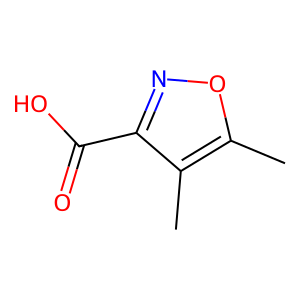
4,5-Dimethylisoxazole-3-carboxylic acid
Names and Identifiers of 4,5-Dimethylisoxazole-3-carboxylic acid
CAS Number |
100047-61-8 |
|---|---|
EC Number |
812-393-3 |
MDL Number |
MFCD05667138 |
IUPAC Name |
4,5-dimethyl-1,2-oxazole-3-carboxylic acid |
InChI |
InChI=1S/C6H7NO3/c1-3-4(2)10-7-5(3)6(8)9/h1-2H3,(H,8,9) |
InChIKey |
KLPASEZGNSBTBD-UHFFFAOYSA-N |
Canonical SMILES |
CC1=C(ON=C1C(=O)O)C |
UNSPSC Code |
12352100 |
Physical and chemical properties of 4,5-Dimethylisoxazole-3-carboxylic acid
Acidity coefficient |
3.14±0.32(Predicted) |
|---|---|
Boiling Point |
318.7ºC at 760mmHg |
Density |
1.276g/cm3 |
Exact Mass |
141.04300 |
Flash Point |
146.5ºC |
Index of Refraction |
1.513 |
LogP |
0.98960 |
Melting Point |
154℃(Solv: benzene (71-43-2)) |
Molecular Formula |
C6H7NO3 |
Molecular Weight |
141.12500 |
PSA |
63.33000 |
Storage condition |
2-8℃ |
Vapour Pressure |
0.000148mmHg at 25°C |
Safety Information of 4,5-Dimethylisoxazole-3-carboxylic acid

Applications of 4,5-Dimethylisoxazole-3-carboxylic acid
4,5-Dimethylisoxazole-3-carboxylic acid finds applications across various fields:
- Chemistry: Serves as a building block for synthesizing more complex heterocyclic compounds.
- Biology: Investigated for its potential as an enzyme inhibitor and its role in biochemical pathways.
- Medicine: Explored for anti-inflammatory, analgesic, and anticancer properties.
- Nanotechnology: Used in modifying the surface of nanoparticles to improve dispersion and incorporation in advanced materials.
Interaction Studies of 4,5-Dimethylisoxazole-3-carboxylic acid
Studies on the interactions of 4,5-Dimethylisoxazole-3-carboxylic acid with biological molecules reveal its potential to modulate enzyme activities by binding to active or allosteric sites. This interaction can significantly influence cellular processes such as signal transduction and gene expression.
Biological Activity of 4,5-Dimethylisoxazole-3-carboxylic acid
Research indicates that 4,5-Dimethylisoxazole-3-carboxylic acid exhibits potential biological activities, particularly in medicinal chemistry. It has been studied for its role as an enzyme inhibitor and its involvement in various biochemical pathways. Notably, this compound has shown antiproliferative activity against cancer cell lines, suggesting its potential as a therapeutic agent in cancer treatment. Its mechanism of action may involve interactions with specific molecular targets, influencing enzyme activity and gene expression.
 Cas:859972-39-7

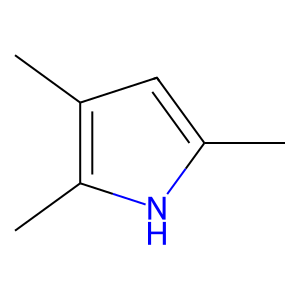 Cas:2199-41-9
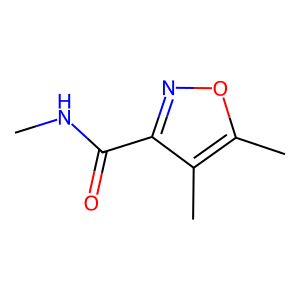 Cas:98334-60-2