![structure of 3-Vinylbicyclo[4.2.0]octa-1,3,5-triene](https://molwiki.oss-cn-hongkong.aliyuncs.com/structure/87/99717-87-0.svg)
3-Vinylbicyclo[4.2.0]octa-1,3,5-triene
CAS No.:
99717-87-0
M. Wt:
130.186
M. Fa:
C10H10
InChI Key:
DTGDMPJDZKDHEP-UHFFFAOYSA-N
Appearance:
Colorless Liquid
Names and Identifiers of 3-Vinylbicyclo[4.2.0]octa-1,3,5-triene
CAS Number |
99717-87-0 |
|---|---|
EC Number |
663-548-5 |
MDL Number |
MFCD09834065 |
IUPAC Name |
3-ethenylbicyclo[4.2.0]octa-1(6),2,4-triene |
InChI |
InChI=1S/C10H10/c1-2-8-3-4-9-5-6-10(9)7-8/h2-4,7H,1,5-6H2 |
InChIKey |
DTGDMPJDZKDHEP-UHFFFAOYSA-N |
Canonical SMILES |
C=CC1=CC2=C(CC2)C=C1 |
UNSPSC Code |
12352100 |
Physical and chemical properties of 3-Vinylbicyclo[4.2.0]octa-1,3,5-triene
Boiling Point |
225.3±30.0 °C at 760 mmHg |
|---|---|
Density |
1.0±0.1 g/cm3 |
Exact Mass |
130.078247 |
Flash Point |
83.7±13.1 °C |
Index of Refraction |
1.624 |
LogP |
3.26 |
Molecular Formula |
C10H10 |
Molecular Weight |
130.186 |
Storage condition |
2-8°C |
Vapour Pressure |
0.1±0.2 mmHg at 25°C |
Safety Information of 3-Vinylbicyclo[4.2.0]octa-1,3,5-triene

Applications of 3-Vinylbicyclo[4.2.0]octa-1,3,5-triene
The unique structure of 3-vinylbicyclo[4.2.0]octa-1,3,5-triene makes it valuable in several applications:
- Material Science: It is used in the development of advanced materials due to its ability to form cross-linked networks upon polymerization.
- Organic Synthesis: The compound serves as an important building block in organic synthesis for producing more complex molecules.
- Chemical Sensors: Its reactivity allows it to be utilized in sensor technologies for detecting specific chemical species.
Interaction Studies of 3-Vinylbicyclo[4.2.0]octa-1,3,5-triene
Interaction studies involving 3-vinylbicyclo[4.2.0]octa-1,3,5-triene have focused on its behavior in various chemical environments and with other reagents:
- Reactivity with Electrophiles: The vinyl group makes the compound susceptible to electrophilic attack, which can lead to various substitution reactions.
- Stability Studies: Investigations into the thermal stability and degradation pathways of this compound reveal insights into its potential applications in high-temperature environments.
Biological Activity of 3-Vinylbicyclo[4.2.0]octa-1,3,5-triene
While specific biological activity data for 3-vinylbicyclo[4.2.0]octa-1,3,5-triene may be limited, compounds with similar structures often exhibit interesting biological properties. Research into related bicyclic compounds suggests potential applications in medicinal chemistry, including anticancer and antimicrobial activities. Further studies are needed to elucidate the specific biological effects of this compound.
Physical sample testing spectrum (NMR) of 3-Vinylbicyclo[4.2.0]octa-1,3,5-triene
![Physical sample testing spectrum (NMR) of 3-Vinylbicyclo[4.2.0]octa-1,3,5-triene](https://molwiki.oss-cn-hongkong.aliyuncs.com/Spectrum/NMR/87/99717-87-0_412201.jpg)
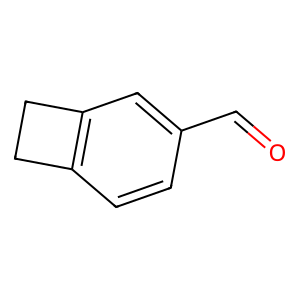 Cas:112892-88-3

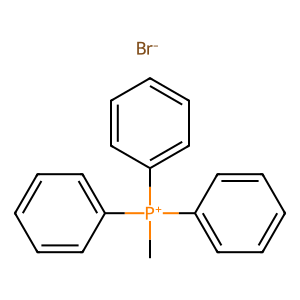 Cas:1779-49-3

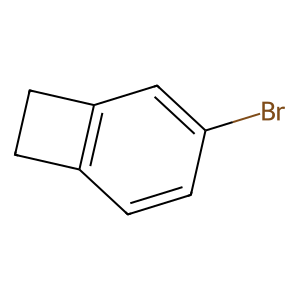 Cas:1073-39-8