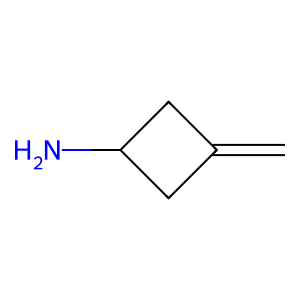
3-Methylenecyclobutanamine
CAS No.:
100114-49-6
M. Wt:
83.13170
M. Fa:
C5H9N
InChI Key:
CCDBTPTWKSVCET-UHFFFAOYSA-N
Names and Identifiers of 3-Methylenecyclobutanamine
CAS Number |
100114-49-6 |
|---|---|
IUPAC Name |
3-methylidenecyclobutan-1-amine |
InChI |
InChI=1S/C5H9N/c1-4-2-5(6)3-4/h5H,1-3,6H2 |
InChIKey |
CCDBTPTWKSVCET-UHFFFAOYSA-N |
Canonical SMILES |
C=C1CC(C1)N |
Physical and chemical properties of 3-Methylenecyclobutanamine
Acidity coefficient |
9.45±0.20(Predicted) |
|---|---|
Boiling Point |
98.2±29.0 °C(Predicted) |
Density |
0.90±0.1 g/cm3(Predicted) |
Exact Mass |
83.07350 |
LogP |
1.36400 |
Molecular Formula |
C5H9N |
Molecular Weight |
83.13170 |
PSA |
26.02000 |
Safety Information of 3-Methylenecyclobutanamine

Applications of 3-Methylenecyclobutanamine
The unique structure of 3-Methylenecyclobutanamine makes it a candidate for various applications:
- Pharmaceutical Development: Its potential biological activity positions it as a candidate for further investigation in drug design, particularly for conditions related to neurotransmitter dysregulation.
- Synthetic Intermediates: It can serve as an intermediate in the synthesis of more complex organic molecules, particularly those involving cyclic structures.
Interaction Studies of 3-Methylenecyclobutanamine
Interaction studies involving 3-Methylenecyclobutanamine focus on its effects on neurotransmitter systems. While specific data on this compound are scarce, analogs have been shown to interact with serotonin, norepinephrine, and dopamine transporters. These interactions may lead to increased levels of these neurotransmitters in the synaptic cleft, contributing to potential stimulant effects.
 Cas:15760-35-7

 Cas:15760-36-8
 Cas:98426-11-0