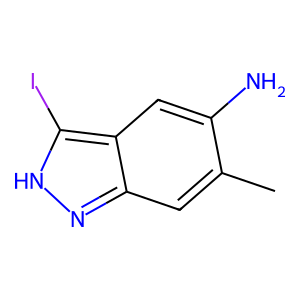
3-Iodo-6-methyl-1H-indazol-5-amine
Names and Identifiers of 3-Iodo-6-methyl-1H-indazol-5-amine
CAS Number |
1000343-40-7 |
|---|---|
IUPAC Name |
3-iodo-6-methyl-2H-indazol-5-amine |
InChI |
InChI=1S/C8H8IN3/c1-4-2-7-5(3-6(4)10)8(9)12-11-7/h2-3H,10H2,1H3,(H,11,12) |
InChIKey |
KHCABMPYPIFRLE-UHFFFAOYSA-N |
Canonical SMILES |
CC1=CC2=NNC(=C2C=C1N)I |
Physical and chemical properties of 3-Iodo-6-methyl-1H-indazol-5-amine
Acidity coefficient |
13.03±0.40(Predicted) |
|---|---|
Boiling Point |
449.3±40.0 °C at 760 mmHg |
Density |
2.0±0.1 g/cm3 |
Exact Mass |
272.976288 |
Flash Point |
225.5±27.3 °C |
Index of Refraction |
1.811 |
LogP |
2.44 |
Molecular Formula |
C8H8IN3 |
Molecular Weight |
273.074 |
PSA |
54.70000 |
Storage condition |
2-8°C |
Vapour Pressure |
0.0±1.1 mmHg at 25°C |
Applications of 3-Iodo-6-methyl-1H-indazol-5-amine
3-Iodo-6-methyl-1H-indazol-5-amine has potential applications in various fields:
- Pharmaceutical Development: Due to its IDO1 inhibitory activity, it is being investigated for its potential use in cancer therapies and other diseases where modulation of the kynurenine pathway is beneficial.
- Organic Synthesis: The compound serves as an intermediate in synthesizing more complex organic molecules, making it valuable in heterocyclic chemistry.
Interaction Studies of 3-Iodo-6-methyl-1H-indazol-5-amine
Interaction studies involving 3-Iodo-6-methyl-1H-indazol-5-amine focus on its binding affinity with various biological targets. Techniques such as surface plasmon resonance or isothermal titration calorimetry are commonly employed to assess how well this compound interacts with proteins or enzymes involved in disease processes. Preliminary results suggest promising interactions that warrant further investigation to elucidate mechanisms of action and optimize therapeutic potential.
Biological Activity of 3-Iodo-6-methyl-1H-indazol-5-amine
3-Iodo-6-methyl-1H-indazol-5-amine exhibits significant biological activity, primarily through its role as an inhibitor of indoleamine 2,3-dioxygenase 1 (IDO1). This inhibition affects the kynurenine pathway, which is critical for tryptophan metabolism. The compound has demonstrated anti-proliferative activity in certain cancer cell lines by inducing apoptosis via the activation of the p53/MDM2 pathway. Additionally, it interacts with various enzymes and proteins, influencing cellular processes such as signaling pathways and gene expression.