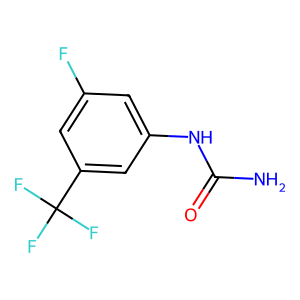
3-Fluoro-5-(trifluoromethyl)phenylurea
Names and Identifiers of 3-Fluoro-5-(trifluoromethyl)phenylurea
CAS Number |
1000588-76-0 |
|---|---|
IUPAC Name |
[3-fluoro-5-(trifluoromethyl)phenyl]urea |
InChI |
InChI=1S/C8H6F4N2O/c9-5-1-4(8(10,11)12)2-6(3-5)14-7(13)15/h1-3H,(H3,13,14,15) |
InChIKey |
PXTBMIPPRBHALF-UHFFFAOYSA-N |
Canonical SMILES |
C1=C(C=C(C=C1NC(=O)N)F)C(F)(F)F |
Physical and chemical properties of 3-Fluoro-5-(trifluoromethyl)phenylurea
Exact Mass |
222.04200 |
|---|---|
LogP |
3.10840 |
Molecular Formula |
C8H6F4N2O |
Molecular Weight |
222.14000 |
PSA |
55.12000 |
Applications of 3-Fluoro-5-(trifluoromethyl)phenylurea
3-Fluoro-5-(trifluoromethyl)phenylurea finds applications across various fields:
- Medicinal Chemistry: It serves as a building block for synthesizing more complex fluorinated compounds that may possess therapeutic properties.
- Agricultural Chemistry: The compound may have potential uses in developing agrochemicals due to its biological activity.
- Material Science: Its unique properties make it suitable for creating specialty chemicals and materials with enhanced characteristics.
Interaction Studies of 3-Fluoro-5-(trifluoromethyl)phenylurea
Studies investigating the interactions of 3-Fluoro-5-(trifluoromethyl)phenylurea with biological systems indicate that its fluorinated structure enhances binding affinity to specific proteins and enzymes. These interactions are vital for understanding how the compound might modulate biological pathways or exhibit therapeutic effects. Techniques such as molecular docking and affinity assays are commonly employed to elucidate these interactions.
Biological Activity of 3-Fluoro-5-(trifluoromethyl)phenylurea
The biological activity of 3-Fluoro-5-(trifluoromethyl)phenylurea has garnered attention due to its potential applications in medicinal chemistry. The compound's fluorinated nature enhances its interaction with biological targets, such as enzymes and receptors. Preliminary studies suggest that it may exhibit significant activity against various cancer cell lines, making it a candidate for further pharmacological investigation. The incorporation of trifluoromethyl groups is known to increase lipophilicity, which can improve membrane permeability and bioavailability.
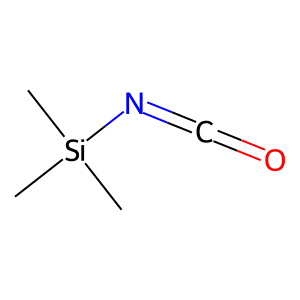 Cas:1118-02-1

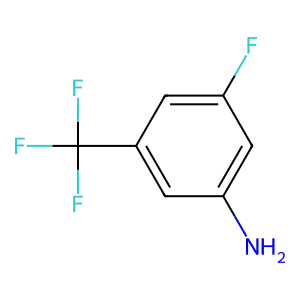 Cas:454-67-1
