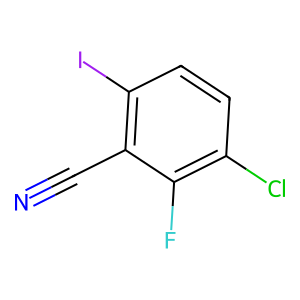
3-Chloro-2-fluoro-6-iodobenzonitrile
Names and Identifiers of 3-Chloro-2-fluoro-6-iodobenzonitrile
CAS Number |
1000577-68-3 |
|---|---|
MDL Number |
MFCD09800808 |
IUPAC Name |
3-chloro-2-fluoro-6-iodobenzonitrile |
InChI |
InChI=1S/C7H2ClFIN/c8-5-1-2-6(10)4(3-11)7(5)9/h1-2H |
InChIKey |
VRQDSPDXKQJULR-UHFFFAOYSA-N |
Canonical SMILES |
N#CC1=C(I)C=CC(Cl)=C1F |
UNSPSC Code |
12352100 |
Physical and chemical properties of 3-Chloro-2-fluoro-6-iodobenzonitrile
Boiling Point |
286.3±40.0 °C at 760 mmHg |
|---|---|
Density |
2.1±0.1 g/cm3 |
Exact Mass |
280.890442 |
Flash Point |
126.9±27.3 °C |
Index of Refraction |
1.644 |
LogP |
3.08 |
Molecular Formula |
C7H2ClFIN |
Molecular Weight |
281.453 |
Vapour Pressure |
0.0±0.6 mmHg at 25°C |
Safety Information of 3-Chloro-2-fluoro-6-iodobenzonitrile

Applications of 3-Chloro-2-fluoro-6-iodobenzonitrile
3-Chloro-2-fluoro-6-iodobenzonitrile finds applications in various fields:
- Organic Synthesis: It acts as a building block for synthesizing more complex organic molecules.
- Biochemical Research: The compound can be utilized in developing bioactive molecules or as a probe in biochemical assays.
- Industrial Chemistry: It serves as an intermediate in producing specialty chemicals and materials.
Interaction Studies of 3-Chloro-2-fluoro-6-iodobenzonitrile
Interaction studies involving 3-Chloro-2-fluoro-6-iodobenzonitrile focus on its ability to bind with specific molecular targets in biological systems. The presence of multiple halogens may facilitate interactions through halogen bonding, enhancing the compound's affinity for certain receptors or enzymes. Understanding these interactions is crucial for exploring its therapeutic potential and guiding further drug development efforts.
Biological Activity of 3-Chloro-2-fluoro-6-iodobenzonitrile
While specific biological activity data for 3-Chloro-2-fluoro-6-iodobenzonitrile is limited, compounds with similar structures often exhibit significant biological properties. The presence of halogen atoms may enhance interactions with biological targets, potentially leading to applications in drug development. The compound could serve as a scaffold for designing bioactive molecules or probes in biochemical studies.