![structure of 3-Bromopyrimido[1,2-a]benzimidazole](https://molwiki.oss-cn-hongkong.aliyuncs.com/structure/35/1000932-35-3.svg)
3-Bromopyrimido[1,2-a]benzimidazole
CAS No.:
1000932-35-3
M. Wt:
248.07900
M. Fa:
C10H6BrN3
InChI Key:
VEXDSLZOKLRXIT-UHFFFAOYSA-N
Names and Identifiers of 3-Bromopyrimido[1,2-a]benzimidazole
CAS Number |
1000932-35-3 |
|---|---|
IUPAC Name |
3-bromopyrimido[1,2-a]benzimidazole |
InChI |
InChI=1S/C10H6BrN3/c11-7-5-12-10-13-8-3-1-2-4-9(8)14(10)6-7/h1-6H |
InChIKey |
VEXDSLZOKLRXIT-UHFFFAOYSA-N |
Canonical SMILES |
C1=CC=C2C(=C1)N=C3N2C=C(C=N3)Br |
Physical and chemical properties of 3-Bromopyrimido[1,2-a]benzimidazole
Exact Mass |
246.97500 |
|---|---|
LogP |
2.64500 |
Molecular Formula |
C10H6BrN3 |
Molecular Weight |
248.07900 |
PSA |
30.19000 |
Safety Information of 3-Bromopyrimido[1,2-a]benzimidazole

Applications of 3-Bromopyrimido[1,2-a]benzimidazole
The applications of 3-bromopyrimido[1,2-a]benzimidazole span several fields:
- Pharmaceuticals: Due to its biological activity, it is being investigated for potential use in developing new antimicrobial and anticancer drugs.
- Material Science: Its unique properties may also lend themselves to applications in organic electronics or as precursors in polymer synthesis.
- Research Tool: It serves as a valuable intermediate for synthesizing other complex heterocyclic compounds used in various research applications.
Interaction Studies of 3-Bromopyrimido[1,2-a]benzimidazole
Interaction studies have focused on the compound's ability to bind with various biological targets. For instance:
- Enzyme Inhibition: Studies have shown that derivatives can inhibit specific enzymes involved in cancer cell proliferation.
- Receptor Binding: The compound's structure allows it to interact with cellular receptors, potentially modulating signaling pathways associated with disease states.
These interactions underscore the compound's potential as a lead structure for drug development.
Biological Activity of 3-Bromopyrimido[1,2-a]benzimidazole
3-Bromopyrimido[1,2-a]benzimidazole exhibits significant biological activity, particularly as an antimicrobial and anticancer agent. Research indicates that derivatives of this compound can inhibit the growth of various cancer cell lines and possess antibacterial properties. The unique structural features allow for interaction with biological targets, making it a subject of interest in drug discovery.
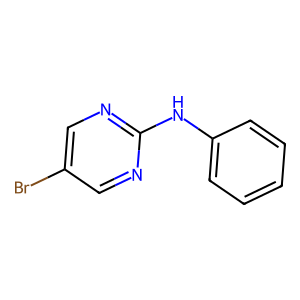 Cas:886365-88-4

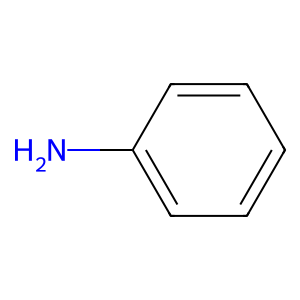 Cas:62-53-3