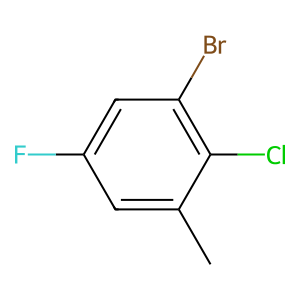
3-Bromo-2-chloro-5-fluorotoluene
CAS No.:
1000576-68-0
M. Wt:
223.470
M. Fa:
C7H5BrClF
InChI Key:
WVPIMQSHAFMKIB-UHFFFAOYSA-N
Appearance:
Yellow Solid
Names and Identifiers of 3-Bromo-2-chloro-5-fluorotoluene
CAS Number |
1000576-68-0 |
|---|---|
MDL Number |
MFCD09800774 |
IUPAC Name |
1-bromo-2-chloro-5-fluoro-3-methylbenzene |
InChI |
InChI=1S/C7H5BrClF/c1-4-2-5(10)3-6(8)7(4)9/h2-3H,1H3 |
InChIKey |
WVPIMQSHAFMKIB-UHFFFAOYSA-N |
Canonical SMILES |
CC1=CC(=CC(=C1Cl)Br)F |
UNSPSC Code |
12352100 |
Physical and chemical properties of 3-Bromo-2-chloro-5-fluorotoluene
Boiling Point |
226.7±35.0 °C at 760 mmHg |
|---|---|
Density |
1.6±0.1 g/cm3 |
Exact Mass |
221.924713 |
Flash Point |
90.9±25.9 °C |
Index of Refraction |
1.545 |
LogP |
3.95 |
Molecular Formula |
C7H5BrClF |
Molecular Weight |
223.470 |
Vapour Pressure |
0.1±0.4 mmHg at 25°C |
Safety Information of 3-Bromo-2-chloro-5-fluorotoluene

Applications of 3-Bromo-2-chloro-5-fluorotoluene
3-Bromo-2-chloro-5-fluorotoluene serves several important roles in various fields:
- Organic Synthesis Intermediate: It is widely used as a building block in synthesizing more complex organic molecules.
- Pharmaceutical Development: Its unique structure makes it a candidate for developing new drugs, particularly in creating selective androgen receptor modulators and other therapeutic agents.
- Material Science: The compound can be utilized in developing advanced materials due to its unique electronic properties imparted by the halogens.
Interaction Studies of 3-Bromo-2-chloro-5-fluorotoluene
Research into interaction studies involving 3-Bromo-2-chloro-5-fluorotoluene has primarily focused on its metabolic pathways and interactions with biological systems:
- Metabolic Pathways: Studies have indicated that this compound may undergo metabolic transformations mediated by cytochrome P450 enzymes, affecting its pharmacokinetics and potential toxicity.
- Receptor Binding Studies: Investigations into how this compound interacts with androgen receptors have highlighted its potential as a selective modulator, contributing to ongoing research in endocrine therapies.
Several compounds share structural similarities with 3-Bromo-2-chloro-5-fluorotoluene. Here are a few notable examples:
| Compound Name | Structural Characteristics | Unique Features |
|---|---|---|
| 3-Bromo-4-chloro-5-fluorotoluene | Bromine at position 3, chlorine at position 4 | Different regioselectivity affecting reactivity |
| 2-Bromo-5-chloro-6-fluorotoluene | Bromine at position 2, chlorine at position 5 | Variation in biological activity |
| 4-Bromo-2-chloro-6-fluorotoluene | Bromine at position 4, chlorine at position 2 | Potentially different synthesis pathways |
Biological Activity of 3-Bromo-2-chloro-5-fluorotoluene
The biological activity of 3-Bromo-2-chloro-5-fluorotoluene has been studied in relation to its potential pharmacological applications. It has shown:
- CYP Enzyme Inhibition: This compound acts as an inhibitor for certain cytochrome P450 enzymes, particularly CYP1A2, which is involved in drug metabolism.
- Potential Antitumor Activity: Some studies suggest that compounds with similar structures may exhibit anticancer properties, although specific data on this compound's efficacy is limited and requires further investigation.