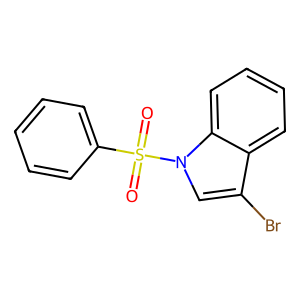
3-Bromo-1-(phenylsulfonyl)-1H-indole
Names and Identifiers of 3-Bromo-1-(phenylsulfonyl)-1H-indole
CAS Number |
99655-68-2 |
|---|---|
EC Number |
629-133-8 |
MDL Number |
MFCD02681986 |
IUPAC Name |
1-(benzenesulfonyl)-3-bromoindole |
InChI |
InChI=1S/C14H10BrNO2S/c15-13-10-16(14-9-5-4-8-12(13)14)19(17,18)11-6-2-1-3-7-11/h1-10H |
InChIKey |
MXPFKHHDXIJNDX-UHFFFAOYSA-N |
Canonical SMILES |
C1=CC=C(C=C1)S(=O)(=O)N2C=C(C3=CC=CC=C32)Br |
UNSPSC Code |
12352100 |
Physical and chemical properties of 3-Bromo-1-(phenylsulfonyl)-1H-indole
Boiling Point |
498.0±37.0 °C at 760 mmHg |
|---|---|
Density |
1.6±0.1 g/cm3 |
Exact Mass |
334.961548 |
Flash Point |
255.0±26.5 °C |
Index of Refraction |
1.669 |
LogP |
4.48 |
Melting Point |
122-126 °C(lit.) |
Molecular Formula |
C14H10BrNO2S |
Molecular Weight |
336.204 |
PSA |
47.45000 |
Storage condition |
2-8°C |
Vapour Pressure |
0.0±1.3 mmHg at 25°C |
Safety Information of 3-Bromo-1-(phenylsulfonyl)-1H-indole

Applications of 3-Bromo-1-(phenylsulfonyl)-1H-indole
3-Bromo-1-(phenylsulfonyl)-1H-indole finds applications in various domains:
- Organic Synthesis: It serves as a building block for synthesizing more complex organic molecules.
- Pharmaceutical Development: Its potential as a serotonin receptor modulator makes it valuable in drug discovery and development for treating psychiatric disorders.
- Material Science: Compounds derived from this indole may be utilized in creating functional materials due to their unique electronic properties.
Interaction Studies of 3-Bromo-1-(phenylsulfonyl)-1H-indole
Interaction studies involving 3-Bromo-1-(phenylsulfonyl)-1H-indole focus primarily on its binding affinity and activity towards serotonin receptors and other biological targets. These studies often employ techniques such as:
- Radioligand Binding Assays: To determine binding affinities to specific receptors.
- Cellular Assays: To evaluate functional outcomes of receptor activation or inhibition.
- Molecular Docking Studies: To predict how this compound interacts at the molecular level with various targets.
Such studies are essential for understanding its mechanism of action and therapeutic potential.
Biological Activity of 3-Bromo-1-(phenylsulfonyl)-1H-indole
Research indicates that 3-Bromo-1-(phenylsulfonyl)-1H-indole exhibits notable biological activity, particularly as a potential ligand for serotonin receptors. Its derivatives have been studied for their interactions with various biological targets, including:
- Serotonin Receptors: This compound shows promise in modulating serotonin receptor activity, which is crucial in treating mood disorders and other neuropsychiatric conditions.
- Anticancer Properties: Some studies suggest that compounds related to this indole derivative may possess anticancer properties, possibly through mechanisms involving apoptosis or cell cycle arrest.
The specific biological activities depend on the functional groups attached and the structural modifications made to the indole core.
Physical sample testing spectrum (NMR) of 3-Bromo-1-(phenylsulfonyl)-1H-indole

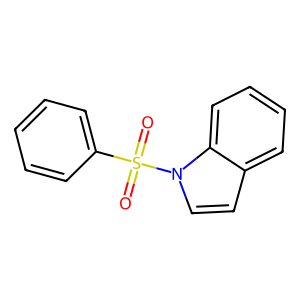 Cas:40899-71-6

 Cas:1484-27-1

 Cas:98-09-9