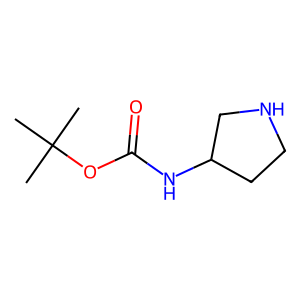
3-(tert-Butoxycarbonylamino)pyrrolidine
CAS No.:
99724-19-3
M. Wt:
186.251
M. Fa:
C9H18N2O2
InChI Key:
DQQJBEAXSOOCPG-UHFFFAOYSA-N
Appearance:
Pale-yellow Solid
Names and Identifiers of 3-(tert-Butoxycarbonylamino)pyrrolidine
CAS Number |
99724-19-3 |
|---|---|
EC Number |
639-392-9 |
MDL Number |
MFCD00059040 |
IUPAC Name |
tert-butyl N-pyrrolidin-3-ylcarbamate |
InChI |
InChI=1S/C9H18N2O2/c1-9(2,3)13-8(12)11-7-4-5-10-6-7/h7,10H,4-6H2,1-3H3,(H,11,12) |
InChIKey |
DQQJBEAXSOOCPG-UHFFFAOYSA-N |
Canonical SMILES |
CC(C)(C)OC(=O)NC1CCNC1 |
UNSPSC Code |
12352100 |
Physical and chemical properties of 3-(tert-Butoxycarbonylamino)pyrrolidine
Acidity coefficient |
12.37±0.20(Predicted) |
|---|---|
Boiling Point |
286.4±29.0 °C at 760 mmHg |
Density |
1.0±0.1 g/cm3 |
Exact Mass |
186.136826 |
Flash Point |
127.0±24.3 °C |
Index of Refraction |
1.480 |
LogP |
0.93 |
Melting Point |
67ºC |
Molecular Formula |
C9H18N2O2 |
Molecular Weight |
186.251 |
PSA |
50.36000 |
Sensitivity |
Air Sensitive |
Solubility |
Soluble in Methanol(almost transparency). |
Storage condition |
2-8°C |
Vapour Pressure |
0.0±0.6 mmHg at 25°C |
Safety Information of 3-(tert-Butoxycarbonylamino)pyrrolidine

Applications of 3-(tert-Butoxycarbonylamino)pyrrolidine
3-(tert-Butoxycarbonylamino)pyrrolidine has several applications:
- Pharmaceutical Intermediate: It serves as a crucial intermediate in the synthesis of various pharmaceutical compounds, particularly those requiring amino functionalities.
- Building Block for Complex Molecules: The compound is utilized as a building block for synthesizing complex organic molecules, including those with biological activity.
- Protecting Group in Organic Synthesis: Its role as a protecting group allows chemists to selectively modify other functional groups without interference from the amino group.
Interaction Studies of 3-(tert-Butoxycarbonylamino)pyrrolidine
Interaction studies involving 3-(tert-Butoxycarbonylamino)pyrrolidine primarily focus on its derivatives and their interactions with biological targets. Research indicates that certain derivatives interact effectively with enzymes and receptors, demonstrating potential therapeutic effects. These studies often assess binding affinities and inhibition rates to evaluate the efficacy of these compounds in drug development.
Biological Activity of 3-(tert-Butoxycarbonylamino)pyrrolidine
The biological activity of 3-(tert-Butoxycarbonylamino)pyrrolidine has been explored primarily through its derivatives. Certain derivatives have shown potential as inhibitors against various biological targets, including:
- EGFR Tyrosine Kinase: Some derivatives exhibit inhibitory activity against epidermal growth factor receptor (EGFR) tyrosine kinase, which is crucial in cancer therapies.
- Bacterial Cell Division Inhibitors: Compounds derived from 3-(tert-Butoxycarbonylamino)pyrrolidine have been identified as potent inhibitors of bacterial cell division, indicating its potential in antibiotic development.
Physical sample testing spectrum (NMR) of 3-(tert-Butoxycarbonylamino)pyrrolidine

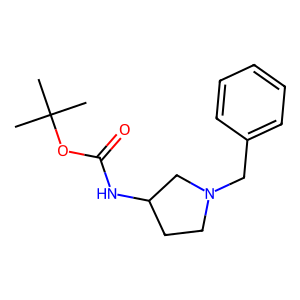 Cas:99735-30-5

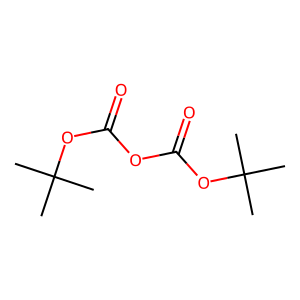 Cas:24424-99-5

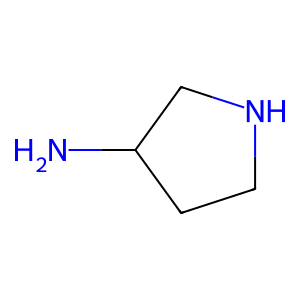 Cas:79286-79-6