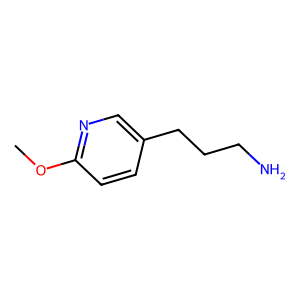
3-(6-Methoxypyridin-3-YL)propan-1-amine
Names and Identifiers of 3-(6-Methoxypyridin-3-YL)propan-1-amine
CAS Number |
1000521-37-8 |
|---|---|
EC Number |
828-973-4 |
IUPAC Name |
3-(6-methoxypyridin-3-yl)propan-1-amine |
InChI |
InChI=1S/C9H14N2O/c1-12-9-5-4-8(7-11-9)3-2-6-10/h4-5,7H,2-3,6,10H2,1H3 |
InChIKey |
CXRMNOBHRZVQQS-UHFFFAOYSA-N |
Canonical SMILES |
COC1=NC=C(C=C1)CCCN |
Physical and chemical properties of 3-(6-Methoxypyridin-3-YL)propan-1-amine
Molecular Formula |
C9H14N2O |
|---|---|
Molecular Weight |
166.22 |
Safety Information of 3-(6-Methoxypyridin-3-YL)propan-1-amine

Applications of 3-(6-Methoxypyridin-3-YL)propan-1-amine
3-(6-Methoxypyridin-3-yl)propan-1-amine has numerous applications across various fields:
- Organic Synthesis: It serves as an intermediate in the synthesis of more complex organic molecules.
- Biological Research: The compound is utilized in studying enzyme interactions and receptor binding, contributing to drug discovery efforts.
- Agrochemicals: It can also be applied in the production of agrochemicals and specialty chemicals due to its unique chemical properties.
Interaction Studies of 3-(6-Methoxypyridin-3-YL)propan-1-amine
Research into the interaction studies of 3-(6-Methoxypyridin-3-yl)propan-1-amine focuses on its binding affinity to various biological targets. Mechanistic studies are ongoing to elucidate how this compound affects specific pathways within biological systems. Its potential as a neuroprotective agent has garnered attention, particularly in relation to its ability to modulate neuronal survival mechanisms.
Biological Activity of 3-(6-Methoxypyridin-3-YL)propan-1-amine
The biological activity of 3-(6-Methoxypyridin-3-yl)propan-1-amine has been explored in various studies. It is known to interact with specific molecular targets, such as enzymes and receptors, potentially modulating their activity. The methoxypyridine ring facilitates hydrogen bonding and π-π interactions, while the amine group can form ionic bonds with negatively charged sites on target molecules. These interactions may lead to diverse biological effects, including neuroprotective properties and other therapeutic applications.