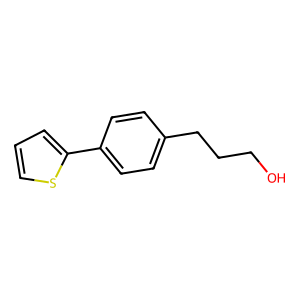
3-(4-Thiophen-2-yl-phenyl)-propan-1-ol
Names and Identifiers of 3-(4-Thiophen-2-yl-phenyl)-propan-1-ol
CAS Number |
1000572-36-0 |
|---|---|
IUPAC Name |
3-(4-thiophen-2-ylphenyl)propan-1-ol |
InChI |
InChI=1S/C13H14OS/c14-9-1-3-11-5-7-12(8-6-11)13-4-2-10-15-13/h2,4-8,10,14H,1,3,9H2 |
InChIKey |
XMKHSFFAXUJXAM-UHFFFAOYSA-N |
Canonical SMILES |
C1=CSC(=C1)C2=CC=C(C=C2)CCCO |
Applications of 3-(4-Thiophen-2-yl-phenyl)-propan-1-ol
3-(4-Thiophen-2-yl-phenyl)-propan-1-ol has diverse applications in various fields:
- Medicinal Chemistry: Its unique structure allows for potential development into pharmaceuticals targeting specific diseases.
- Organic Electronics: The compound's electronic properties make it suitable for applications in organic light-emitting diodes and solar cells.
- Material Science: It can be used in the development of new materials with tailored properties for specific applications .
Interaction Studies of 3-(4-Thiophen-2-yl-phenyl)-propan-1-ol
Studies investigating the interactions of 3-(4-Thiophen-2-yl-phenyl)-propan-1-ol with biological targets have shown promising results. For example, docking studies suggest that this compound can bind effectively to certain receptors, influencing their activity. This property is particularly valuable in drug design, as it provides insights into how modifications to the compound's structure could enhance its efficacy against specific targets .
Biological Activity of 3-(4-Thiophen-2-yl-phenyl)-propan-1-ol
The biological activity of 3-(4-Thiophen-2-yl-phenyl)-propan-1-ol is primarily attributed to its interaction with specific molecular targets. The thiophene ring system is known to engage with various enzymes and receptors, potentially leading to inhibition or activation of biological pathways. For instance, it may exhibit antimicrobial properties through enzyme inhibition or anticancer activity by modulating receptor interactions. The precise mechanisms of action depend on the specific biological targets involved .