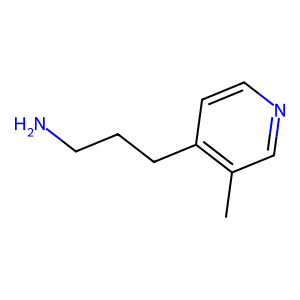
3-(3-Methylpyridin-4-yl)propan-1-amine
CAS No.:
1000521-04-9
M. Wt:
150.22
M. Fa:
C9H14N2
InChI Key:
LQARVRGPLPRMOX-UHFFFAOYSA-N
Names and Identifiers of 3-(3-Methylpyridin-4-yl)propan-1-amine
CAS Number |
1000521-04-9 |
|---|---|
IUPAC Name |
3-(3-methylpyridin-4-yl)propan-1-amine |
InChI |
InChI=1S/C9H14N2/c1-8-7-11-6-4-9(8)3-2-5-10/h4,6-7H,2-3,5,10H2,1H3 |
InChIKey |
LQARVRGPLPRMOX-UHFFFAOYSA-N |
Canonical SMILES |
CC1=C(C=CN=C1)CCCN |
Physical and chemical properties of 3-(3-Methylpyridin-4-yl)propan-1-amine
Molecular Formula |
C9H14N2 |
|---|---|
Molecular Weight |
150.22 |
Safety Information of 3-(3-Methylpyridin-4-yl)propan-1-amine

Applications of 3-(3-Methylpyridin-4-yl)propan-1-amine
3-(3-Methylpyridin-4-yl)propan-1-amine has potential applications in various fields:
- Pharmaceuticals: Due to its biological activity, it may serve as a lead compound for developing new medications targeting neurological disorders.
- Chemical Research: It can be utilized as an intermediate in organic synthesis, particularly in creating more complex molecular architectures.
Interaction Studies of 3-(3-Methylpyridin-4-yl)propan-1-amine
Interaction studies involving 3-(3-Methylpyridin-4-yl)propan-1-amine focus on its binding affinity to various biological targets. Preliminary studies suggest that it may interact with neurotransmitter receptors, although specific binding studies are necessary to confirm these interactions and elucidate their implications for drug design.
Biological Activity of 3-(3-Methylpyridin-4-yl)propan-1-amine
Research indicates that 3-(3-Methylpyridin-4-yl)propan-1-amine exhibits significant biological activities. It has been studied for its potential as:
- Neuroprotective Agent: Certain derivatives of pyridine-based compounds have shown promise in protecting neuronal cells from damage.
- Antidepressant Properties: Some studies suggest that similar compounds may influence neurotransmitter systems, potentially offering antidepressant effects.
The specific biological activity of 3-(3-Methylpyridin-4-yl)propan-1-amine requires further investigation to elucidate its mechanisms and therapeutic potential.