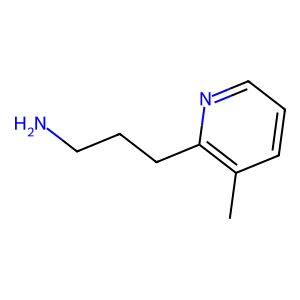
3-(3-Methylpyridin-2-yl)propan-1-amine
Names and Identifiers of 3-(3-Methylpyridin-2-yl)propan-1-amine
CAS Number |
1000512-96-8 |
|---|---|
IUPAC Name |
3-(3-methylpyridin-2-yl)propan-1-amine |
InChI |
InChI=1S/C9H14N2/c1-8-4-3-7-11-9(8)5-2-6-10/h3-4,7H,2,5-6,10H2,1H3 |
InChIKey |
WAUXGDVCSRTHRN-UHFFFAOYSA-N |
Canonical SMILES |
CC1=C(N=CC=C1)CCCN |
Physical and chemical properties of 3-(3-Methylpyridin-2-yl)propan-1-amine
Acidity coefficient |
9.90±0.10(Predicted) |
|---|---|
Boiling Point |
253.4±28.0 °C(Predicted) |
Density |
0.988±0.06 g/cm3(Predicted) |
Molecular Formula |
C9H14N2 |
Molecular Weight |
150.22 |
Applications of 3-(3-Methylpyridin-2-yl)propan-1-amine
The applications of 3-(3-Methylpyridin-2-yl)propan-1-amine span various fields:
- Chemistry: It serves as a building block in organic synthesis for creating more complex molecules.
- Biology: The compound is utilized in studies related to enzyme inhibition and receptor interactions.
- Industry: It is employed in the production of specialty chemicals and intermediates for diverse industrial processes.
Interaction Studies of 3-(3-Methylpyridin-2-yl)propan-1-amine
Interaction studies indicate that 3-(3-Methylpyridin-2-yl)propan-1-amine may exhibit significant interactions with various biological targets. These interactions are essential for understanding its pharmacological potential and therapeutic applications. Ongoing research aims to elucidate these interactions further, which could lead to new insights into drug design and efficacy.
Biological Activity of 3-(3-Methylpyridin-2-yl)propan-1-amine
Research indicates that 3-(3-Methylpyridin-2-yl)propan-1-amine exhibits significant biological activities. It interacts with various receptors and enzymes, contributing to its pharmacological effects. Notably, studies have explored its potential role in enzyme inhibition and receptor binding, which are critical for drug development and therapeutic applications. The compound's biological profile suggests it may be beneficial in treating conditions where modulation of these targets is necessary.