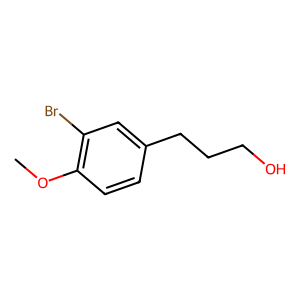
3-(3-Bromo-4-methoxyphenyl)propan-1-ol
Names and Identifiers of 3-(3-Bromo-4-methoxyphenyl)propan-1-ol
CAS Number |
1000530-47-1 |
|---|---|
MDL Number |
MFCD09927370 |
IUPAC Name |
3-(3-bromo-4-methoxyphenyl)propan-1-ol |
InChI |
InChI=1S/C10H13BrO2/c1-13-10-5-4-8(3-2-6-12)7-9(10)11/h4-5,7,12H,2-3,6H2,1H3 |
InChIKey |
ANVIDQUKPNLNIR-UHFFFAOYSA-N |
Canonical SMILES |
COC1=C(C=C(C=C1)CCCO)Br |
UNSPSC Code |
12352100 |
Physical and chemical properties of 3-(3-Bromo-4-methoxyphenyl)propan-1-ol
H Bond Acceptors |
2 |
|---|---|
H Bond Donors |
1 |
LogP |
2.55020727833333 |
Molecular Formula |
C10H13BrO2 |
Molecular Weight |
245.11 |
Safety Information of 3-(3-Bromo-4-methoxyphenyl)propan-1-ol

Applications of 3-(3-Bromo-4-methoxyphenyl)propan-1-ol
3-(3-Bromo-4-methoxyphenyl)propan-1-ol has diverse applications across various fields:
- Chemistry: Serves as an intermediate in synthesizing complex organic molecules and pharmaceuticals.
- Biology: Investigated for its potential biological activities and interactions with biomolecules.
- Medicine: Explored for therapeutic properties and as a precursor in drug development.
- Industry: Utilized in producing specialty chemicals and materials.
Interaction Studies of 3-(3-Bromo-4-methoxyphenyl)propan-1-ol
Interaction studies involving 3-(3-Bromo-4-methoxyphenyl)propan-1-ol focus on its binding affinity to biological targets, including enzymes and receptors. Preliminary findings suggest that this compound may interact with estrogen receptors, indicating potential implications for hormonal therapies. Further research is needed to elucidate the full scope of its biological interactions.
Biological Activity of 3-(3-Bromo-4-methoxyphenyl)propan-1-ol
Research indicates that 3-(3-Bromo-4-methoxyphenyl)propan-1-ol may exhibit significant biological activity, particularly in interactions with various biomolecules. The compound's unique structure allows it to act as a substrate or inhibitor in enzymatic reactions, potentially influencing various biochemical pathways. Its interactions have been studied for potential therapeutic applications, including its effects on hormonal modulation mechanisms.