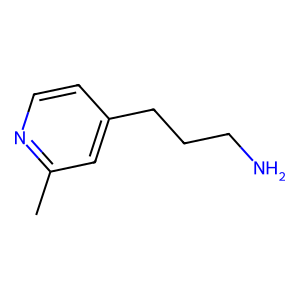
3-(2-methylpyridin-4-yl)propan-1-amine
CAS No.:
1000507-72-1
M. Wt:
150.22
M. Fa:
C9H14N2
InChI Key:
-
Names and Identifiers of 3-(2-methylpyridin-4-yl)propan-1-amine
CAS Number |
1000507-72-1 |
|---|---|
IUPAC Name |
3-(2-methylpyridin-4-yl)propan-1-amine |
Canonical SMILES |
CC1=NC=CC(=C1)CCCN |
Physical and chemical properties of 3-(2-methylpyridin-4-yl)propan-1-amine
Molecular Formula |
C9H14N2 |
|---|---|
Molecular Weight |
150.22 |
Safety Information of 3-(2-methylpyridin-4-yl)propan-1-amine

Applications of 3-(2-methylpyridin-4-yl)propan-1-amine
3-(2-Methyl-pyridin-4-YL)-propylamine has potential applications in:
- Pharmaceuticals: As a building block for drug development targeting various diseases, particularly those involving kinase pathways.
- Chemical Research: Used as an intermediate in synthesizing more complex organic molecules.
- Material Science: Investigated for its properties in creating functional materials due to its unique structural characteristics.
Interaction Studies of 3-(2-methylpyridin-4-yl)propan-1-amine
Studies on the interactions of 3-(2-Methyl-pyridin-4-YL)-propylamine with biological targets indicate its potential as a modulator of enzyme activity. Interaction studies often focus on:
- Binding Affinity: Evaluating how well the compound binds to specific receptors or enzymes.
- Mechanism of Action: Understanding how the compound affects biological pathways and cellular responses.
Biological Activity of 3-(2-methylpyridin-4-yl)propan-1-amine
3-(2-Methyl-pyridin-4-YL)-propylamine exhibits notable biological activities, particularly in pharmacology. Compounds with similar structures have been investigated for their roles as inhibitors of various enzymes and receptors, including:
- Tyrosine Kinase Inhibitors: Some derivatives are known to inhibit tyrosine kinases, which are crucial in cancer signaling pathways.
- Neurotransmitter Modulation: The compound may influence neurotransmitter systems due to its amine functionality, potentially affecting mood and cognition.