
3-(2-Methoxyphenyl)isonicotinic acid
Names and Identifiers of 3-(2-Methoxyphenyl)isonicotinic acid
CAS Number |
100004-81-7 |
|---|---|
MDL Number |
MFCD18207557 |
IUPAC Name |
3-(2-methoxyphenyl)pyridine-4-carboxylic acid |
InChI |
InChI=1S/C13H11NO3/c1-17-12-5-3-2-4-9(12)11-8-14-7-6-10(11)13(15)16/h2-8H,1H3,(H,15,16) |
InChIKey |
MEYHBIZGGUXZHE-UHFFFAOYSA-N |
Canonical SMILES |
COC1=CC=CC=C1C2=C(C=CN=C2)C(=O)O |
UNSPSC Code |
12352100 |
Physical and chemical properties of 3-(2-Methoxyphenyl)isonicotinic acid
Exact Mass |
229.07400 |
|---|---|
H Bond Acceptors |
4 |
H Bond Donors |
1 |
LogP |
2.45540 |
Molecular Formula |
C13H11NO3 |
Molecular Weight |
229.23100 |
PSA |
59.42000 |
Safety Information of 3-(2-Methoxyphenyl)isonicotinic acid

Applications of 3-(2-Methoxyphenyl)isonicotinic acid
The applications of 3-(2-Methoxyphenyl)isonicotinic acid span various fields:
- Pharmaceuticals: As a potential drug candidate for antimicrobial and anti-inflammatory therapies.
- Agriculture: Possible use as a pesticide or herbicide due to its biological activity.
- Material Science: Exploration in developing new materials with specific chemical properties.
Its diverse applications underline the importance of studying this compound further for practical uses.
Interaction Studies of 3-(2-Methoxyphenyl)isonicotinic acid
Interaction studies involving 3-(2-Methoxyphenyl)isonicotinic acid focus on its binding affinity with biological targets such as enzymes and receptors. These studies are crucial for understanding its mechanism of action and therapeutic potential. Preliminary data suggest that it may interact with certain proteins involved in inflammation and cancer pathways, warranting further investigation into its pharmacodynamics and pharmacokinetics.
Biological Activity of 3-(2-Methoxyphenyl)isonicotinic acid
3-(2-Methoxyphenyl)isonicotinic acid exhibits various biological activities that are of significant interest in pharmacology. Preliminary studies suggest that it may possess:
- Antimicrobial Properties: Potential effectiveness against certain bacterial strains.
- Anti-inflammatory Effects: May inhibit inflammatory pathways, contributing to its therapeutic potential.
- Antitumor Activity: Initial findings indicate possible cytotoxic effects on cancer cell lines.
These activities highlight its potential as a lead compound for drug development in treating infections and inflammatory diseases.
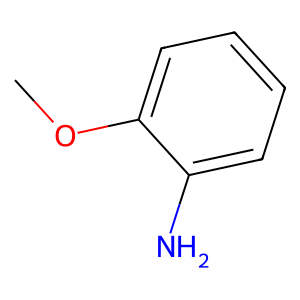 Cas:90-04-0

 Cas:108-89-4