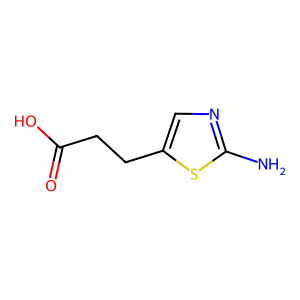
3-(2-AMinothiazol-5-yl)propanoic acid
CAS No.:
100114-40-7
M. Wt:
172.20500
M. Fa:
C6H8N2O2S
InChI Key:
KWNMATRLTBXYKR-UHFFFAOYSA-N
Names and Identifiers of 3-(2-AMinothiazol-5-yl)propanoic acid
CAS Number |
100114-40-7 |
|---|---|
MDL Number |
MFCD18380658 |
IUPAC Name |
3-(2-amino-1,3-thiazol-5-yl)propanoic acid |
InChI |
InChI=1S/C6H8N2O2S/c7-6-8-3-4(11-6)1-2-5(9)10/h3H,1-2H2,(H2,7,8)(H,9,10) |
InChIKey |
KWNMATRLTBXYKR-UHFFFAOYSA-N |
Canonical SMILES |
NC1=NC=C(CCC(=O)O)S1 |
UNSPSC Code |
12352100 |
Physical and chemical properties of 3-(2-AMinothiazol-5-yl)propanoic acid
Exact Mass |
172.03100 |
|---|---|
H Bond Acceptors |
4 |
H Bond Donors |
2 |
LogP |
1.32370 |
Molecular Formula |
C6H8N2O2S |
Molecular Weight |
172.20500 |
PSA |
104.45000 |
Storage condition |
2-8°C |
Safety Information of 3-(2-AMinothiazol-5-yl)propanoic acid

Applications of 3-(2-AMinothiazol-5-yl)propanoic acid
The applications of 3-(2-Aminothiazol-5-yl)propanoic acid span various fields:
- Pharmaceutical Development: As a building block for synthesizing novel drugs targeting infections or cancer.
- Biochemical Research: Used as a probe in studies investigating enzyme activity or metabolic pathways involving amino acids.
- Agricultural Chemistry: Potential use as a pesticide or herbicide due to its biological activity against specific pathogens.
The versatility of this compound makes it a candidate for further exploration in drug discovery and development.
Interaction Studies of 3-(2-AMinothiazol-5-yl)propanoic acid
Interaction studies involving 3-(2-Aminothiazol-5-yl)propanoic acid focus on its binding affinity with various biological targets:
- Enzyme Inhibition: Investigations into how this compound affects enzymes involved in metabolic pathways, particularly those linked to disease states.
- Receptor Binding Studies: Assessing its potential as a ligand for receptors associated with neurotransmission or immune responses.
These studies are crucial for understanding the pharmacodynamics and pharmacokinetics of the compound, which can inform its therapeutic potential.
Biological Activity of 3-(2-AMinothiazol-5-yl)propanoic acid
Research indicates that 3-(2-Aminothiazol-5-yl)propanoic acid exhibits various biological activities, including:
- Antimicrobial Activity: Compounds containing thiazole rings are often evaluated for their ability to inhibit bacterial growth.
- Antitumor Properties: Some studies suggest that derivatives of thiazole can exhibit cytotoxic effects against certain cancer cell lines.
- Neuroprotective Effects: There is emerging evidence that similar compounds may have protective effects on neuronal cells, potentially useful in neurodegenerative diseases.
The specific mechanisms underlying these activities often involve interactions with enzymes or receptors relevant to these biological pathways.