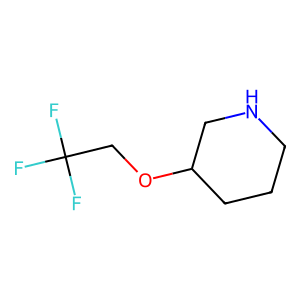
3-(2,2,2-Trifluoroethoxy)piperidine
Names and Identifiers of 3-(2,2,2-Trifluoroethoxy)piperidine
CAS Number |
1000931-80-5 |
|---|---|
MDL Number |
MFCD09971599 |
IUPAC Name |
3-(2,2,2-trifluoroethoxy)piperidine |
InChI |
InChI=1S/C7H12F3NO/c8-7(9,10)5-12-6-2-1-3-11-4-6/h6,11H,1-5H2 |
InChIKey |
LGGONXZZCBEARG-UHFFFAOYSA-N |
Canonical SMILES |
C1CC(CNC1)OCC(F)(F)F |
UNSPSC Code |
12352100 |
Physical and chemical properties of 3-(2,2,2-Trifluoroethoxy)piperidine
Exact Mass |
183.08700 |
|---|---|
H Bond Acceptors |
2 |
H Bond Donors |
1 |
LogP |
1.64610 |
Molecular Formula |
C7H12F3NO |
Molecular Weight |
183.17100 |
PSA |
21.26000 |
Applications of 3-(2,2,2-Trifluoroethoxy)piperidine
3-(2,2,2-Trifluoroethoxy)piperidine has diverse applications:
- Medicinal Chemistry: It serves as a building block for synthesizing more complex pharmaceutical compounds.
- Agrochemicals: The compound is utilized in the development of pesticides and herbicides due to its unique chemical properties.
- Biochemical Research: It plays a role in studying enzyme interactions and metabolic pathways.
Interaction Studies of 3-(2,2,2-Trifluoroethoxy)piperidine
Interaction studies involving 3-(2,2,2-trifluoroethoxy)piperidine have focused on its binding affinity to various biological receptors. Preliminary findings suggest that it may influence neurotransmitter systems, which could have implications for drug development targeting neurological disorders. Further research is necessary to fully elucidate these interactions and their therapeutic potential.
Biological Activity of 3-(2,2,2-Trifluoroethoxy)piperidine
Research indicates that 3-(2,2,2-trifluoroethoxy)piperidine exhibits significant biological activity. It has been studied for its potential role in modulating neurotransmitter systems, making it a candidate for pharmacological applications. The presence of the trifluoroethoxy group may enhance its binding affinity to various receptors, influencing signaling pathways related to mood and cognition. Additionally, it has applications in enzyme interaction studies and metabolic pathway research.