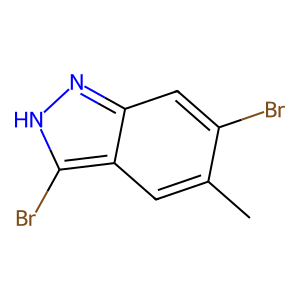
3,6-Dibromo-5-methyl-1H-indazole
CAS No.:
1000342-39-1
M. Wt:
289.955
M. Fa:
C8H6Br2N2
InChI Key:
WQBPPIHTEAQRJE-UHFFFAOYSA-N
Names and Identifiers of 3,6-Dibromo-5-methyl-1H-indazole
CAS Number |
1000342-39-1 |
|---|---|
IUPAC Name |
3,6-dibromo-5-methyl-2H-indazole |
InChI |
InChI=1S/C8H6Br2N2/c1-4-2-5-7(3-6(4)9)11-12-8(5)10/h2-3H,1H3,(H,11,12) |
InChIKey |
WQBPPIHTEAQRJE-UHFFFAOYSA-N |
Canonical SMILES |
CC1=CC2=C(NN=C2C=C1Br)Br |
Physical and chemical properties of 3,6-Dibromo-5-methyl-1H-indazole
Acidity coefficient |
10.83±0.40(Predicted) |
|---|---|
Boiling Point |
399.6±37.0 °C at 760 mmHg |
Density |
2.0±0.1 g/cm3 |
Exact Mass |
287.889771 |
Flash Point |
195.4±26.5 °C |
Index of Refraction |
1.721 |
LogP |
4.12 |
Molecular Formula |
C8H6Br2N2 |
Molecular Weight |
289.955 |
PSA |
28.68000 |
Storage condition |
2-8°C |
Vapour Pressure |
0.0±0.9 mmHg at 25°C |
Applications of 3,6-Dibromo-5-methyl-1H-indazole
3,6-Dibromo-5-methyl-1H-indazole finds applications across various domains:
- Medicinal Chemistry: As a scaffold for developing new drugs due to its biological activity.
- Material Science: Used in synthesizing novel materials with specific electronic or optical properties.
- Nanotechnology: Employed in creating nanomaterials that exhibit enhanced properties for applications in electronics and biomedicine.
Interaction Studies of 3,6-Dibromo-5-methyl-1H-indazole
Studies exploring the interactions of 3,6-Dibromo-5-methyl-1H-indazole with biological targets are crucial for understanding its pharmacological potential. Research has focused on:
- Binding Affinity Studies: Assessing how well the compound interacts with specific proteins or enzymes.
- Mechanistic Studies: Investigating how this compound affects cellular pathways and biological processes.
These studies are essential for evaluating its potential therapeutic uses and understanding its mechanism of action.
Biological Activity of 3,6-Dibromo-5-methyl-1H-indazole
Research indicates that 3,6-Dibromo-5-methyl-1H-indazole exhibits notable biological activities. It has been studied for its potential as:
- Antimicrobial Agent: Some studies suggest that this compound may possess antibacterial and antifungal properties.
- Anticancer Activity: Preliminary research points to its potential in inhibiting cancer cell proliferation, making it a candidate for further pharmacological studies.
- Neuroprotective Effects: There is emerging evidence that it may have protective effects on neuronal cells, potentially useful in neurodegenerative disease research.