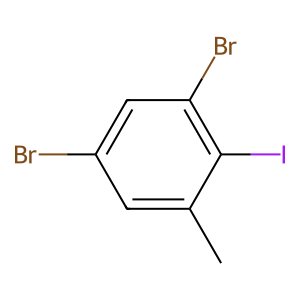
3,5-Dibromo-2-iodotoluene
Names and Identifiers of 3,5-Dibromo-2-iodotoluene
CAS Number |
1000571-43-6 |
|---|---|
MDL Number |
MFCD09800828 |
IUPAC Name |
1,5-dibromo-2-iodo-3-methylbenzene |
InChI |
InChI=1S/C7H5Br2I/c1-4-2-5(8)3-6(9)7(4)10/h2-3H,1H3 |
InChIKey |
NQCYUNDYUJNSAX-UHFFFAOYSA-N |
Canonical SMILES |
CC1=CC(=CC(=C1I)Br)Br |
UNSPSC Code |
12352100 |
Physical and chemical properties of 3,5-Dibromo-2-iodotoluene
Exact Mass |
373.78000 |
|---|---|
LogP |
4.12460 |
Molecular Formula |
C7H5Br2I |
Molecular Weight |
375.82700 |
Safety Information of 3,5-Dibromo-2-iodotoluene

Applications of 3,5-Dibromo-2-iodotoluene
3,5-Dibromo-2-iodotoluene finds applications across several fields:
- Organic Synthesis: It serves as a versatile intermediate for synthesizing more complex organic compounds.
- Material Science: Used as a building block in the development of new materials with specific electronic or optical properties.
- Biochemical Research: Employed in proteomics research for labeling proteins and studying their interactions.
Interaction Studies of 3,5-Dibromo-2-iodotoluene
Studies involving 3,5-dibromo-2-iodotoluene have focused on its interactions with various biological systems. It has been noted for its ability to inhibit specific cytochrome P450 enzymes, which play crucial roles in drug metabolism. Furthermore, its halogenated structure allows it to interact with cellular components, potentially affecting signaling pathways and cellular responses.
Biological Activity of 3,5-Dibromo-2-iodotoluene
The biological activity of 3,5-dibromo-2-iodotoluene has been explored in various studies. It has been shown to exhibit inhibitory effects on certain cytochrome P450 enzymes, specifically CYP1A2 and CYP2C9, which are involved in drug metabolism. This suggests potential applications in pharmacology as a modulator of drug metabolism pathways. Additionally, its structure may allow for interactions with biological targets, making it a candidate for further investigation in medicinal chemistry.