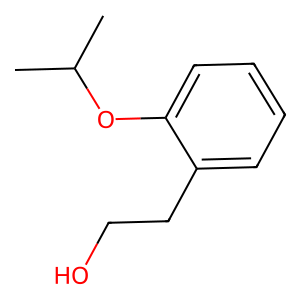
2-iso-Propoxyphenethyl alcohol
Names and Identifiers of 2-iso-Propoxyphenethyl alcohol
CAS Number |
1000505-33-8 |
|---|---|
MDL Number |
MFCD09926383 |
IUPAC Name |
2-(2-propan-2-yloxyphenyl)ethanol |
InChI |
InChI=1S/C11H16O2/c1-9(2)13-11-6-4-3-5-10(11)7-8-12/h3-6,9,12H,7-8H2,1-2H3 |
InChIKey |
ICSGTKCQDRPWBD-UHFFFAOYSA-N |
Canonical SMILES |
CC(C)OC1=CC=CC=C1CCO |
UNSPSC Code |
12352100 |
Physical and chemical properties of 2-iso-Propoxyphenethyl alcohol
Molecular Formula |
C11H16O2 |
|---|---|
Molecular Weight |
180.24 |
Safety Information of 2-iso-Propoxyphenethyl alcohol

Applications of 2-iso-Propoxyphenethyl alcohol
2-(2-Isopropoxyphenyl)ethanol finds applications across various fields:
- Pharmaceutical Industry: It serves as an intermediate in the synthesis of pharmaceutical compounds due to its structural properties and biological activity.
- Chemical Manufacturing: Used as a solvent and reagent in organic synthesis, it facilitates reactions involving other compounds.
- Cosmetics and Personal Care Products: Its properties make it suitable for use in formulations where skin penetration and moisture retention are desired.
- Research
Interaction Studies of 2-iso-Propoxyphenethyl alcohol
Studies on 2-(2-Isopropoxyphenyl)ethanol's interactions focus on its ability to modulate enzyme activity and receptor signaling pathways. The hydroxyl group allows for hydrogen bonding with biological macromolecules, potentially influencing metabolic processes. Research continues into its efficacy as an antimicrobial agent, exploring how structural variations affect its activity against different pathogens.
Biological Activity of 2-iso-Propoxyphenethyl alcohol
Research indicates that 2-(2-Isopropoxyphenyl)ethanol may exhibit biological activities, particularly in antimicrobial and antioxidant domains. The presence of the hydroxyl group enhances its potential to act as a hydrogen donor, which may contribute to its antioxidant properties. Additionally, studies suggest that compounds with similar structures can interact with biological targets, leading to various pharmacological effects.