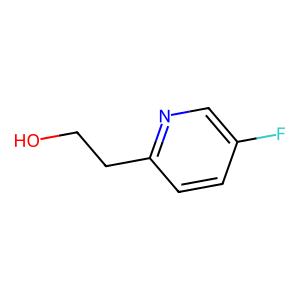
2-Pyridineethanol, 5-fluoro-
Names and Identifiers of 2-Pyridineethanol, 5-fluoro-
CAS Number |
1000521-75-4 |
|---|---|
MDL Number |
MFCD09926281 |
IUPAC Name |
2-(5-fluoropyridin-2-yl)ethanol |
InChI |
InChI=1S/C7H8FNO/c8-6-1-2-7(3-4-10)9-5-6/h1-2,5,10H,3-4H2 |
InChIKey |
OVQRVQOBZKDTQQ-UHFFFAOYSA-N |
Canonical SMILES |
C1=CC(=NC=C1F)CCO |
UNSPSC Code |
12352100 |
Physical and chemical properties of 2-Pyridineethanol, 5-fluoro-
Acidity coefficient |
14.36±0.10(Predicted) |
|---|---|
Boiling Point |
210.6±25.0 °C(Predicted) |
Density |
1.204±0.06 g/cm3(Predicted) |
Exact Mass |
141.05900 |
H Bond Acceptors |
2 |
H Bond Donors |
1 |
LogP |
0.75550 |
Molecular Formula |
C7H8FNO |
Molecular Weight |
141.14300 |
PSA |
33.12000 |
Safety Information of 2-Pyridineethanol, 5-fluoro-

Applications of 2-Pyridineethanol, 5-fluoro-
The applications of 2-(5-Fluoropyridin-2-yl)ethan-1-ol span several fields:
- Medicinal Chemistry: It is explored as a potential drug candidate due to its bioactive properties.
- Material Science: The compound is used in developing advanced materials with enhanced thermal stability and chemical resistance.
- Organic Synthesis: It serves as a versatile building block for synthesizing more complex fluorinated compounds.
Interaction Studies of 2-Pyridineethanol, 5-fluoro-
Studies focusing on the interactions of 2-(5-Fluoropyridin-2-yl)ethan-1-ol with biological systems reveal its potential effects on cellular signaling pathways. Its ability to form strong hydrogen bonds and engage in π–π interactions with receptors enhances its efficacy as a modulator of biological activity. This interaction profile is critical for understanding its mechanism of action and optimizing its pharmacological properties.
Biological Activity of 2-Pyridineethanol, 5-fluoro-
Research indicates that 2-(5-Fluoropyridin-2-yl)ethan-1-ol exhibits significant biological activity, particularly in pharmacological contexts. Its interaction with various biological targets suggests potential applications in treating neurological disorders, due to its ability to modulate neurotransmitter systems. Studies have shown that compounds containing the 5-fluoropyridine moiety often display antimicrobial and anticancer properties, making this compound a candidate for further investigation in drug development.